Common symptoms
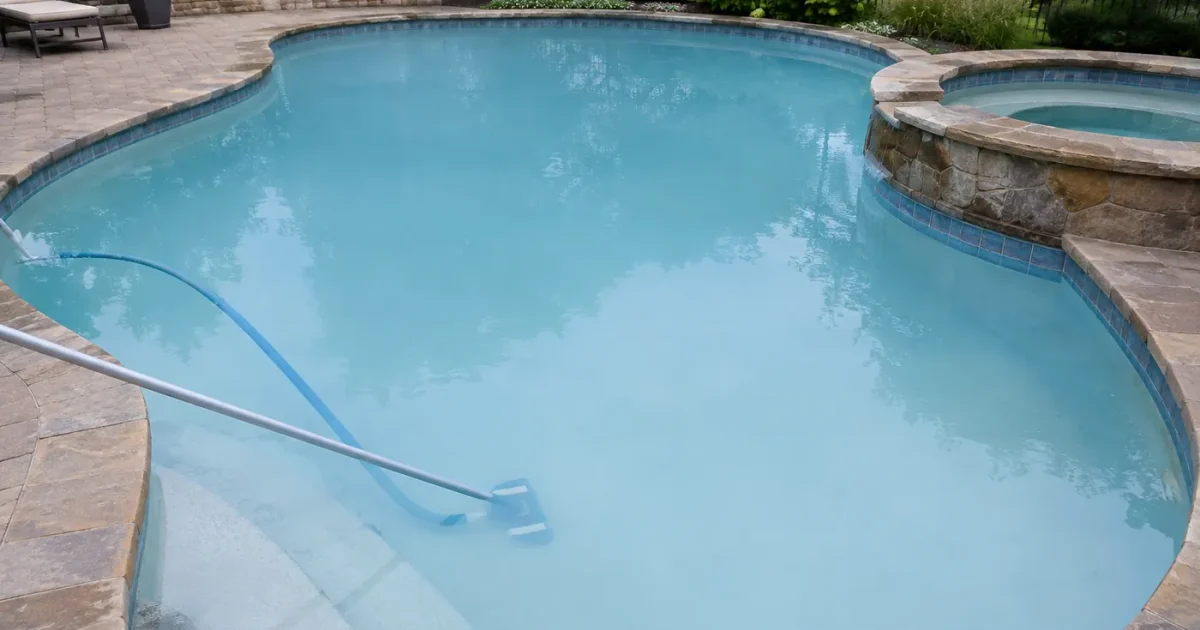
- The water was clear before you vacuumed and is hazy or milky after.
- A cloud of fine dust rises from the floor as the vacuum head passes.
- Dust or silt seems to blow back out of the return jets.
- The water turns hazy green after you vacuum up algae.
- Fine sand or a white powder settles on the floor near the returns.
- The filter gauge reads much higher after vacuuming.
Quick checks before anything else
- The pump is still running so the filter can catch what you stirred up.
- The multiport handle sits fully on Filter, not between settings or on Recirculate.
- If you backwashed, you ran Rinse before going back to Filter.
- The filter gauge is not 8 to 10 psi above its clean pressure.
- Free chlorine and pH test in range.
- No flocculant or clarifier went in before a robot cleaner ran.
Why does a pool get cloudy after vacuuming?
- Fine dust passing the filter Particles smaller than your filter can catch go right back into the pool. Sand filters stop only the larger particles of the three filter types.
- Wrong valve setting Recirculate bypasses the filter, and skipping Rinse after a backwash sends dirty water back to the pool.
- Dirty or overloaded filter A heavy load of dirt through the filter pushes pressure up and flow down.
- Broken filter parts Sand or DE (the white filter powder) on the pool floor points to a cracked lateral or a torn grid.
- Algae or low chlorine Vacuuming stirs up dead or living algae, and the water turns hazy or hazy green.
- Robot cleaner issues A full robot filter, or running a robot after a clarifier or flocculant, leaves fine dirt behind.
- Look at the floorLight dust, or a heavy layer of silt, leaves or dead algae?
- Check your filterSand or DE with a multiport valve, or cartridge?
- Heavy debris and a Waste setting?
Yes: stop the pump, set the valve to Waste, then vacuum. The dirt goes out the waste line instead of through the filter. Watch the water level and top up after.
No: vacuum on Filter, slowly, and let the pump run afterward. Check the gauge and clean the filter if the pressure jumps.
Stop. Keep everyone out until the water clears. CDC says to make sure you can see the drain at the bottom of the deep end before you swim. Turn the pump off before you move the multiport handle, as Hayward directs. If you add chemicals, follow the label, add them to water one at a time, and never mix them.
Step-by-step: how to fix a pool that is cloudy after vacuuming
Most of the time a pool cloudy after vacuuming clears once the filter catches up. The steps below help it catch up faster, then fix what made it cloudy so it does not happen next time.
- Keep the pump running. Vacuuming lifts fine dirt into the water, and only the filter can take it back out. LaMotte’s fix for cloudy water from poor filtration includes running the filter for 24 hours. Leave the pump on and check the water again later.
- Check the valve setting. Turn the pump off, then make sure the multiport handle sits fully on Filter. Hayward’s own list for water that won’t clear includes checking that the valve is set to Filter. Recirculate sends water back to the pool without filtering it.
- Run Rinse if you backwashed. If you backwashed after vacuuming, Hayward says to run Rinse for about 1/2 to 1 minute on its sand filter before returning to Filter, so dirty water in the tank goes to waste instead of the pool. On its Pro-Grid DE filter, Hayward’s rinse is about 20 seconds, then fresh DE goes in.
- Read the filter gauge. A load of dirt through the filter can push pressure up fast. If the gauge is 8 to 10 psi above the clean pressure, backwash a sand or DE filter or hose off the cartridge. Hayward’s DE manual says to backwash after vacuuming if required. Our pool filter pressure guide explains how to read it.
- Look for sand or DE in the pool. Fine sand near the return jets points to a cracked lateral (one of the slotted fingers at the bottom of a sand filter). White DE puffing back in points to a torn grid or too much DE, which Hayward lists as causes. Both mean the filter is letting dirt through, and both need repair before the water will stay clear.
- Test chlorine and pH. CDC gives a typical chlorine range of 1 to 4 ppm (parts per million) and a pH of 7.0 to 7.8. If chlorine is low, vacuuming may have stirred up algae, and the haze can turn green. Use our pool calculator for doses based on your pool volume, and see cloudy pool water if the haze has a chemistry cause.
- Vacuum heavy debris to Waste next time. Hayward says regular vacuuming can go through the filter on the Filter setting, but heavy debris should be vacuumed on Waste so it bypasses the filter and goes out the drain line. Waste also drops the water level, so top up the pool afterward. A cartridge filter has no backwash or Waste setting of its own.
- Vacuum slowly. We move the vacuum head slowly and in overlapping rows, so the fine dust gets picked up instead of lifted into the water. Fast strokes throw silt into the water where the filter has to catch it later.
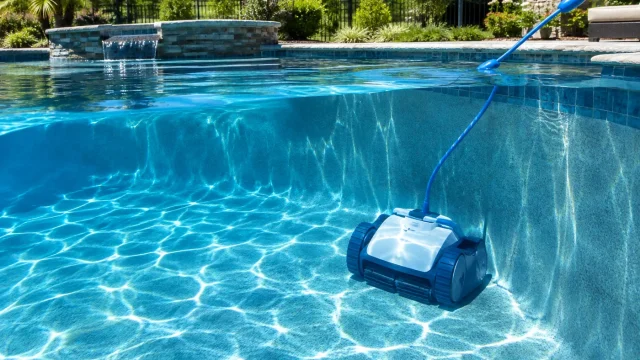
- Clean a robot cleaner’s filter. Dolphin recommends cleaning its robot’s filter after every cycle, and it pairs coarse net filters for large debris with ultra-fine filters for daily use. Dolphin also says not to run its robots after adding a flocculant or clarifier, because those obstruct and damage the robot’s filters. Our robotic pool cleaner not working guide covers robot filter and impeller checks.
- Use a flocculant only as a last step. A flocculant (floc) sinks debris, dead algae and other particles to the pool floor; Clorox Pool&Spa describes it as setting up a quick vacuum clean-up. Follow the bottle’s directions exactly and vacuum the settled layer to Waste so it does not go back through the filter. LaMotte says to consult a pool pro if cloudiness persists, since repeated treatments or a clarifier may be recommended.
- Run the pump long enough every day. Hayward says to run the filter long enough each day for at least one complete turnover (the whole pool’s water passing through the filter once). LaMotte suggests a turnover at least every six hours in moderate to heavily used pools.
Sand vs cartridge vs DE when you vacuum
| Filter | What it catches (Hayward) | Vacuuming notes |
|---|---|---|
| Sand | Particles down to about 20 to 40 microns | Vacuum on Filter for light dirt, Waste for heavy debris; Rinse after any backwash |
| Cartridge | Particles down to about 10 to 20 microns | No backwash or Waste setting; hose off the cartridge if pressure jumps |
| DE | The finest of the three, down to a few microns | Can vacuum straight into the filter; backwash after if needed, then add fresh DE |
A micron is a millionth of a meter, far smaller than a grain of sand. Sand filters are the most likely to let very fine dust back into the pool for a while, so they benefit most from vacuuming heavy dirt to Waste. With a cartridge filter, watch the gauge after a big vacuum job. For more on vacuums, robots and suction cleaners, see the pool lights and cleaners hub.
When to call a pool or spa pro
- The water stays cloudy after a day of filtering with chlorine and pH in range. LaMotte says to consult a pro if cloudiness persists.
- Sand or DE keeps coming back into the pool.
- The filter pressure stays high right after a full cleaning.
- You cannot see the main drain at the deep end and it is not improving.
- The haze turns green and keeps coming back after shocking.
Common questions
Why does my pool turn cloudy after I vacuum it?
Vacuuming lifts fine dirt into the water faster than the filter can catch it, and the finest particles can pass through a sand filter. A valve left on Recirculate, a skipped Rinse after backwashing, or a dirty or damaged filter makes it worse. Low chlorine can add algae haze to the mix.
How do I clear up the cloudiness in my pool?
Keep the pump running, set the valve fully on Filter, and clean the filter if the pressure is up. Then test chlorine and pH and fix them. LaMotte’s advice for cloudy water from poor filtration is to clean the filter and run it for 24 hours.
Do I add more chlorine if my pool is cloudy?
Only if the test shows chlorine is low. CDC gives 1 to 4 ppm as the typical chlorine range. If chlorine is in range and the pool went cloudy right after vacuuming, the problem is filtration, not chlorine, so more chlorine will not clear it.
Will shock clear a cloudy pool?
Shock clears cloudiness caused by algae or used-up chlorine. It will not fix haze from fine dust, a dirty filter or a valve on the wrong setting. After shocking, run the filter and clean it as the pressure rises.
Should I vacuum my pool on Filter or Waste?
Hayward says to use Filter for regular vacuuming and Waste for heavy debris, so the load skips the filter and goes out the drain line. Vacuuming to Waste lowers the water level, so add water afterward. Cartridge filters have no Waste setting.
Does vacuuming a pool get rid of algae?
Not by itself. Vacuuming removes algae you have already killed and brushed loose, but living algae needs chlorine to kill it. LaMotte’s treatment for hazy, slightly green water is to superchlorinate and brush the pool surfaces, then the filter and vacuum clear out what is left.