Common symptoms
- Free chlorine reads fine in the evening and near zero by the next afternoon.
- You add more chlorine every day than you used to, and the level still won’t hold.
- The pool smells strongly of chlorine, yet the free chlorine test reads low.
- Walls or steps feel slippery, or the water has a faint green or dull look.
- Chlorine falls fastest on hot, sunny days, after rain, or after a pool party.
Quick checks before anything else
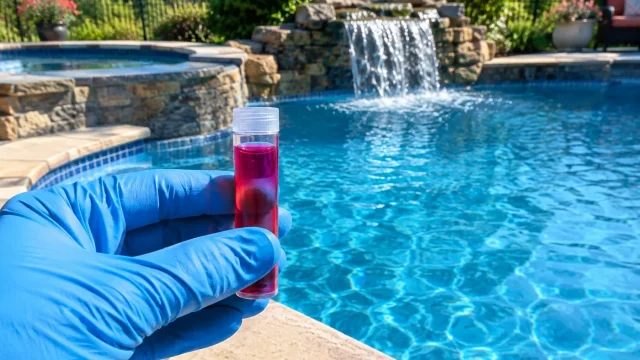
- Test with a DPD drop kit, not only strips. CDC says strips are less accurate.
- Test both free and total chlorine. You need both numbers.
- Test cyanuric acid (CYA), the stabilizer that shields chlorine from the sun.
- Check pH. It changes how hard your chlorine works.
- Check how many hours a day the pump runs, and whether your feeder or salt cell is actually working.
- Think back: heavy rain, a lot of swimmers, lawn fertilizer near the pool, or a recent algaecide?
What is using up the chlorine?
- Sunlight with low stabilizer Pentair says the sun’s UV destroys 90% of unstabilized chlorine within two hours.
- Swimmers and debris CDC lists pee, poop, sweat and dirt from swimmers as things that lower chlorine. Rain, leaves and pets add to it, says Jandy.
- Combined chlorine Chlorine that has reacted with waste stops working and still shows on a total chlorine test. LaMotte says to shock once it reaches 0.2 ppm (parts per million).
- Hidden algae LaMotte notes that by the time you can see algae, there are already billions of cells using chlorine.
- Nitrates, phosphates and metals Pentair says nitrates and phosphates can create very high chlorine demand, and that copper and iron can cause chlorine loss.
- Low pH or warm water LaMotte says chlorine burns off quickly at low pH, and Hayward says very warm pools use more chlorine.
Step-by-step: find what is eating your chlorine
Pool chlorine keeps dropping for two kinds of reasons: the sun burns it off, or something in the water uses it up. These steps tell the two apart, starting with free tests and ending with lab tests. For chlorine amounts, follow your product label and use our pool calculator.
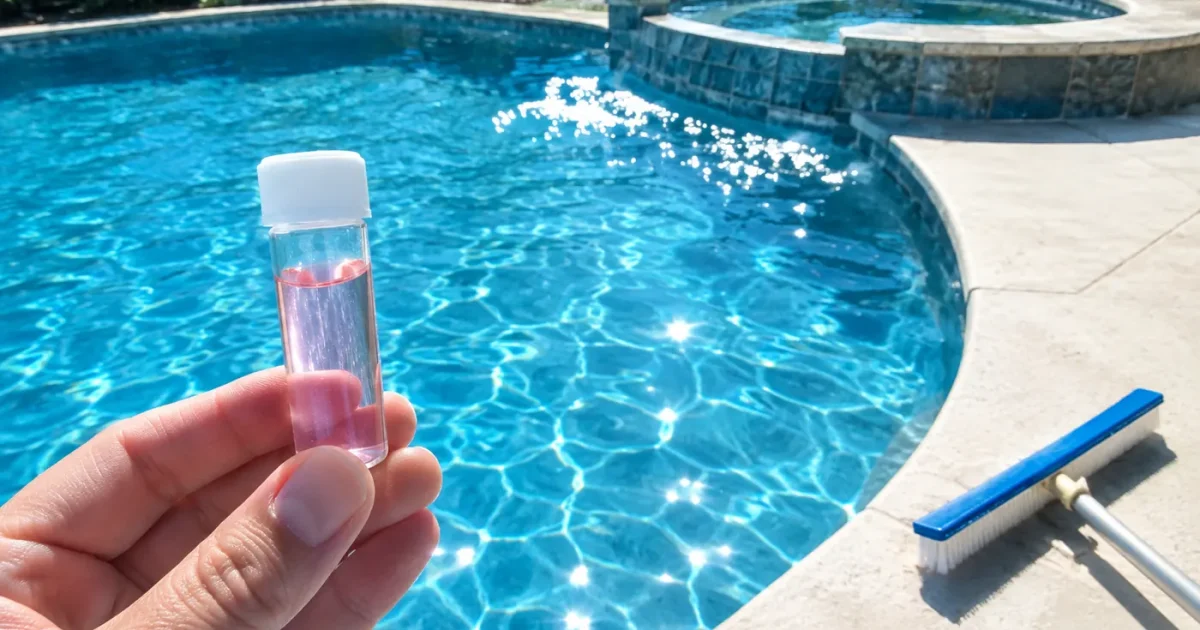
- Get a trustworthy reading. CDC recommends a DPD test kit and says to test chlorine and pH at least twice a day, more often when many people swim. Take the sample away from return jets and feeders, as LaMotte advises. If a DPD sample flashes pink and then goes clear, LaMotte says chlorine is above 10 ppm, not zero.
- Work out combined chlorine. Total chlorine minus free chlorine equals combined chlorine, the used-up kind that smells and stings eyes. LaMotte says to shock when combined chlorine is above 0.2 ppm, and to reach breakpoint by adding about 10 times the combined chlorine level. A pool full of combined chlorine soaks up your daily dose before it can show as free chlorine.
- Test stabilizer. Taylor, a test kit maker, puts the ideal CYA range at 30 to 50 ppm for outdoor pools. With too little, the sun takes most of your chlorine in a few hours, which is the classic “gone by afternoon” pattern. With too much, Taylor says chlorine gets “locked” and works slowly, so algae can grow even with chlorine in the water. CYA only comes down when you drain part of the water and refill.
- Run an overnight check. This is our own method, and it needs only your test kit. Test free chlorine at sunset, keep everyone out, and test again at sunrise. With no sun and no swimmers, the level should hold fairly steady. A clear drop overnight means something in the water is using chlorine, such as algae or organic waste, and the next steps will find it.
- Put pH in range. CDC’s range is 7.0 to 7.8, and LaMotte calls 7.2 to 7.6 ideal. LaMotte says chlorine dissipates quickly when pH is low, and CDC says chlorine kills germs less well as pH rises, especially above 8.0. If pH keeps creeping up, see pool pH that won’t go down.
- Hunt for hidden algae. Brush the walls, steps, corners, behind ladders and around the light. Slimy spots mean algae. LaMotte’s treatment for green algae is to check pH, shock and brush, and for black algae spots it calls for hard brushing, spot treating and a shock to 30 ppm. Keep at least 2.0 ppm of free chlorine at all times afterward, as LaMotte advises. If the whole pool is turning, follow our green pool water guide.
- Test nitrates and phosphates. A pool store or lab can run these. Pentair says nitrates should not exceed 10 ppm and phosphates should stay under 125 ppb (parts per billion), and that nitrates can drop chlorine to zero. LaMotte gives under 10 ppm nitrate and under 100 ppb phosphate. LaMotte also says nitrates can only be removed by draining, while phosphate removers are sold for the other nutrient. Keep lawn fertilizer out of the pool.
- Test for metals. Pentair says copper and iron can cause chlorine loss and stain the pool. If the water is clear but tinted, read our guide to green pool water with no algae before adding more chlorine.
- Check the equipment that makes or feeds chlorine. Hayward lists a short filter time, under 8 hours a day for an average pool, as a cause of little or no chlorine in salt pools. Tablet feeders can run empty or clog. If you have a salt system, our salt water pool turning green guide walks through the cell checks.
- Adjust for heat, rain and swimmers. Hayward says chlorine demand goes up with water temperature, and Pentair says to raise salt cell output after heavy rain, in hotter weather, and when more people swim. One calcium hypochlorite label we checked says to add its shock in the evening, when the pool is not in use. We like that timing, since the sun has hours less to burn it off.
Stop. Never mix two pool chemicals, and never add chlorine and acid at the same time or from the same scoop. CDC warns that mixed pool chemicals can injure people. Keep everyone out of the water while chlorine is above your normal swimming level.
Liquid chlorine vs tablets vs salt: how your chlorine source changes the problem
The kind of chlorine you use decides which causes are most likely. The stabilizer figures come from Taylor.
| Chlorine source | Adds stabilizer? | What to watch when chlorine won’t hold |
|---|---|---|
| Liquid chlorine | No | Low CYA lets the sun burn it off; add stabilizer to 30 to 50 ppm |
| Cal-hypo granules | No | Same sun loss as liquid; it also adds calcium |
| Trichlor tablets | Yes, 7 ppm CYA per pound in 10,000 gallons | CYA climbs all season and slows chlorine down |
| Dichlor | Yes, 6 to 7 ppm per pound in 10,000 gallons | Same CYA buildup, worst when used for shocking |
| Salt chlorinator | No | Makes chlorine only while the pump runs; salt, scale, cold water and output setting |
A pool on trichlor tablets that loses chlorine late in the summer often has the opposite problem from a new liquid chlorine pool. We test CYA before anything else in tablet pools, because adding more tablets to a pool with high CYA only makes it worse. Taylor suggests a temporary switch to unstabilized chlorine while you lower CYA by partial draining.
When to call a pool or spa pro
- Chlorine still drops overnight after you shock, brush and fix pH.
- Nitrates are high, since the only fix LaMotte gives is draining and refilling.
- CYA is far above 50 ppm and you need to know how much water to replace.
- Metals show up in a test, or stains appear on the walls.
- A salt cell, tablet feeder or chlorine controller seems to make or deliver too little.
Our pool chemistry hub shows how chlorine, pH, alkalinity and CYA work together.
Common questions
What to do if your pool is low on chlorine?
Add chlorine to bring free chlorine back up right away, then find the cause. Test CYA, pH and combined chlorine, and brush for algae. If it keeps happening, the overnight check in step 4 tells you whether the sun or something in the water is to blame.
Can you swim in a pool with very low chlorine?
We would not. CDC recommends at least 1 ppm of free chlorine in pools, and at least 2 ppm if you use stabilizer. Below that, chlorine may not kill germs fast enough.
Will shock raise free chlorine?
A chlorine shock will, and that is its job. A non-chlorine shock, the persulfate kind, will not: LaMotte says it breaks down combined chlorine but does not raise free chlorine. If your free chlorine is low, use a chlorine product.
How do you raise your free chlorine in a saltwater pool?
Raise the output setting, run the pump longer, or use the boost or super chlorinate mode, which runs the cell at full output for up to 24 hours on Hayward, Pentair and Jandy systems. If chlorine still will not rise, Pentair and Jandy both say to super chlorinate with chlorine from an outside source. Then check salt, CYA and the cell for scale.
What are normal chlorine levels for a pool?
CDC’s floor is 1 ppm of free chlorine, or 2 ppm with stabilizer. LaMotte calls 2.0 to 4.0 ppm ideal for pools. Pentair warns that keeping it above 4.0 ppm in a salt pool may corrode metal parts.
Can I just add chlorine to my pool?
Yes, to get through the day, and you should not let it sit at zero. But if you have to add more every day, adding more only treats the symptom. Find whether the sun, algae, waste or nutrients are using it, or you will keep paying for chlorine that disappears.