Common symptoms
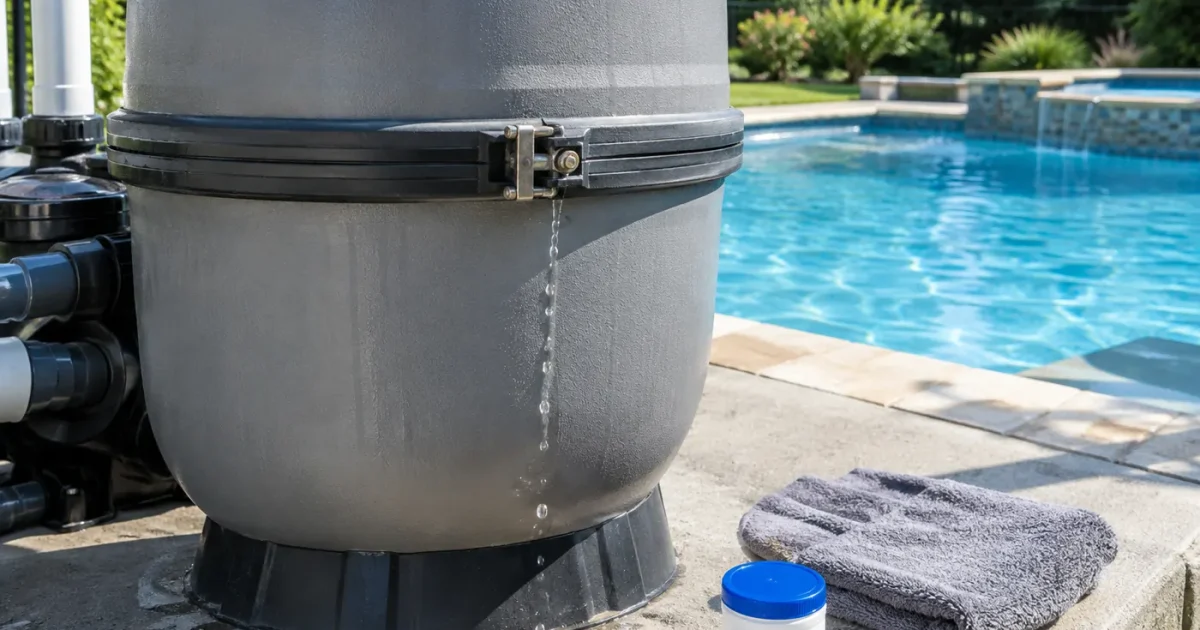
- Water drips or sprays from the band clamp around the tank.
- A cartridge filter seeps at the lid seam right after you cleaned it.
- Water keeps trickling out of the backwash or waste line while the valve is set to Filter.
- Drips form around the multiport valve handle or the valve cover screws.
- A union nut or threaded pipe fitting next to the filter stays wet.
- A puddle forms under the drain cap at the bottom of the tank.
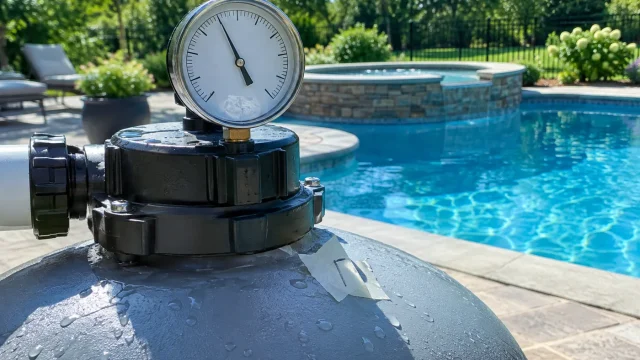
- Water seeps from the air relief valve or the pressure gauge on top.
Quick checks before anything else
- Towel everything dry, run the pump, and watch where the first drop forms.
- The air relief valve is closed after it let out a steady stream of water at startup.
- The drain cap or drain plug at the bottom of the tank is in place and snug.
- The multiport handle sits fully in the Filter notch, not between two settings.
- The gauge reads well under the 50 psi limit while running, and zero with the pump off.
- The water is not coming from the pump beside the filter and running under the tank.
What causes a pool filter to leak?
- Pinched or dirty tank O-ring A leak at the clamp or lid, often right after cleaning. Pentair lists a pinched O-ring first for its cartridge filter.
- Clamp not seated or not tight Water weeps all around the band, or the leak starts the moment the pump starts.
- Worn valve seat gasket Water runs out the backwash line on Filter. Hayward says the gasket inside the valve may be worn or loose.
- Union or threaded fitting A drip where pipe meets the valve, the tank or the pump, from a dirty O-ring or a fitting that is too loose or too tight.
- Drain cap, gauge or air relief valve Small leaks at the bottom or the top of the tank from a missing O-ring or worn thread tape.
- Cracked tank or valve body Water from a hairline crack that no O-ring will stop.
- Power offPump and any timer or automation off at the breaker
- Open the air relief valveStand clear while pressure bleeds off
- Close suction and return valvesSo the pool does not drain back into the tank
- Drain the tankRemove the drain plug or cap
- Gauge reads zero psi?
Yes: hold the clamp halves together, remove the clamp nut, and lift the lid by its body, never by the air relief valve.
No: do not touch the clamp. Wait, and check that the air relief valve is really open.
Stop. Pentair warns that trapped air can launch a filter lid with deadly force. Never tighten or loosen a clamp while the pump has power. If water leaks from under the clamp at startup, Pentair and Hayward both say to shut off the pump and its power right away.
Step-by-step: how to fix a leaking pool filter
We start with leaks you can fix without opening the tank, then move to the clamp, the valve and the plumbing. Check your own model’s manual for its exact numbers. For how filters work, see our pool filter problems hub.
- Find the exact leak spot. Dry everything, start the pump, and watch for the first drop. A puddle under the tank may start at a union or at the pump. A drip from under the pump motor is a pump problem, covered in our pool pump problems guide.
- Check the air relief valve and gauge. Water from the air relief valve is normal at startup; Hayward says to close it only once a steady stream of water (not air) comes out. If it still drips when closed, Pentair says to clean the valve and make sure its stem O-rings are in good shape and lubricated with silicone lube. A gauge that weeps at its threads needs fresh thread tape: Hayward and Pentair both call for two wraps. Pentair says to replace a gauge that does not read zero with the pressure off.
- Check the drain cap. Hayward says the drain cap must be securely in place to prevent leaks, and its DE filter manual notes the drain plug needs an O-ring to seal. Replace an O-ring that is missing, flat or cracked.
- Shut down and release pressure. Follow the flow chart above before you touch any clamp. The gauge must read zero.
- Clean and reseat the tank O-ring. This is the usual fix for a leak at the clamp or lid. Pentair says to rock a stuck lid gently side to side and never pry it with tools, which can damage the O-ring. Wipe the O-ring and its groove clean, check for flat spots, cuts or cracks, and replace it if you find any. Seat it evenly along the flange, then check that it is not pinched when the lid goes on.
- Use the right lubricant. Pentair says to use only PTFE or silicone based lubricant on O-rings and seals, because petroleum based products damage the equipment. Hayward recommends Jack’s 327 lubricant for the O-rings on its DE filter valve. Hayward also says not to lubricate the metal reinforced body seal on its Pro-Grid DE filter, so check your manual before you grease a seal.
- Tighten the clamp to the maker’s spec. Clamps differ a lot by model (see the table below). Pentair’s Clean and Clear Plus clamp nut goes to 16 to 18 ft-lbs, with a 1/2 to 3/4 inch gap left between the clamp ends. Hayward’s Pro-Grid DE clamp goes to 150 inch-lbs with a torque wrench. More force than the spec can damage parts and still not stop the leak.
- Restart the right way. Open the air relief valve, open the suction and return valves, stand clear, and start the pump. Close the air relief valve once a solid stream of water comes out. Pentair says something is wrong if water leaks from under the clamp, or if the gauge shows pressure before water flows from the valve. If so, cut the power and go back to step 5.
- Fix water running out the backwash line. If water flows to waste while the handle is on Filter, Hayward points to a worn or loose valve seat gasket. With the pump off, set the handle to Winterize, mark the cover’s position, remove the cover screws and lift out the key. Hayward says to clean out the old gasket and glue, then glue in a new gasket and let it dry 24 hours. You get one chance to seat it, so Hayward suggests a dealer if you are unsure.
- Fix leaks at the valve cover or handle. A drip at the cover screws points to the cover O-ring. Hayward says to wipe debris off the cover O-ring, line up the flat edge, and tighten the cover screws evenly and alternately without overtightening. Hayward warns that the valve spring is under compression, so remove the handle pin only to service the key O-ring. To protect the valve seal, always shut off the pump and press the handle down before you turn it.
- Reseal unions and threaded fittings. Jandy’s pump manual says to remove, clean and reinstall the union O-rings; with clean O-rings, hand tightening should seal, and if not, snug it gently with large tongue-and-groove pliers without overtightening. For threaded fittings, Hayward’s valve manual says hand tight plus one to 1-1/2 turns at most, with Teflon tape or Permatex No. 2. A loose union on the suction side often sucks in air instead of dripping; see pool pump not priming.
- Look for cracks. Check the tank, valve body and bulkhead fittings with a flashlight. Hayward says not to run the system if any component is damaged, so a cracked part gets replaced, not patched.
Sand vs cartridge vs DE: where each one leaks
Leak points depend on how the tank is built. Find the closest row, then use your own manual.
| Filter (manual we used) | Main seal | Clamp or closure spec |
|---|---|---|
| Sand, top-mount valve (Hayward ProSeries) | Valve/tank O-ring under the flange clamp | Tighten with a screwdriver, tapping around the clamp to seat it |
| Sand, side-mount valve (Hayward ProSeries) | Dome O-ring, plus two valve-to-tank O-rings at the bulkheads | Bulkhead locknuts and clamp: do not overtighten |
| Cartridge (Pentair Clean and Clear Plus) | Tank O-ring between lid and base | 16 to 18 ft-lbs; 1/2 to 3/4 inch gap at the clamp ends |
| DE (Hayward Pro-Grid) | Metal reinforced body seal (do not lubricate) | 150 inch-lbs with a torque wrench; never hand tight only |
On side-mount sand filters, check the two bulkhead connections too. Hayward and Pentair both say never to run or pressure-test these filters above 50 psi. If a leak comes with odd gauge readings, our pool filter pressure guide helps you read the gauge.
When to call a pool or spa pro
- You see a crack in the tank, the valve body or a bulkhead fitting.
- The clamp still leaks after a clean or new O-ring and the maker’s tightening spec. Do not keep adding force.
- A glued PVC joint is leaking. That means cutting out and regluing pipe.
- You are not comfortable replacing a valve seat gasket. Hayward suggests an authorized dealer for this repair.
- Water is pooling near the pump motor or wiring.
Common questions
Why is my pool filter leaking from the top?
On a sand or DE filter with a top-mount valve, it is usually the O-ring between the valve and the tank, or a loose clamp. On a cartridge filter, it is usually the lid O-ring, often pinched during reassembly. The air relief valve or the gauge threads can also drip.
How do I fix a leaking pool filter?
Find the exact leak spot first, because each spot has its own fix. A clamp leak needs a clean tank O-ring and the clamp tightened to spec; water out the backwash line needs a new valve seat gasket.
Why is my pool filter leaking even after I backwash it?
If water keeps running out the backwash line after you set the valve back to Filter, Hayward points to a worn or loose valve seat gasket inside the multiport valve. Turning the handle while the pump runs can damage that seal, so always stop the pump first. If the leak is at the clamp instead, the tank O-ring may have shifted.
Is it normal for a pool filter to leak?
No. Apart from water out of the air relief valve while you bleed air at startup, a filter should be dry. Pentair lists water leaking from under the clamp as a sign the system is not working properly.
How do I know if my pool filter valve is bad?
Water flowing out the backwash or waste line while the handle is on Filter points to a worn valve seat gasket. Drips at the cover screws point to the cover O-ring. A handle that will not seat in its notches, or a crack in the valve body, means the valve or its key needs replacing.
Can a cracked pool filter be repaired?
We do not recommend patching a cracked filter tank or valve body. The tank works under pressure, and Hayward says not to run the system if any component is damaged. Replace the cracked part with the one listed for your model number.