Common symptoms
- The gauge reads higher than usual and the return jets push less water.
- Pressure climbs back up within days of a backwash or cleaning.
- Pressure stays high even right after you backwash.
- The gauge reads lower than your normal clean number, with weak flow at the jets.
- The gauge sits at zero while the pump runs.
- The needle jumps around, or the gauge shows pressure with the pump off.
Quick checks before anything else
- You know your clean pressure: the reading right after the last backwash or cleaning.
- The skimmer and pump baskets are empty.
- The water level is high enough that the skimmer is not sucking air.
- The multiport handle sits fully on Filter, and the suction and return valves are open.
- The gauge drops to zero when the pump is off.
- A variable speed pump is running at the same speed as when you noted your clean pressure.
What causes high or low filter pressure?
- Dirty filter Pressure up 8 to 10 psi over clean, with weaker flow at the jets. The normal reason to backwash or clean.
- Clogged media Pressure stays high right after cleaning: a crusted sand bed, cartridges coated with oils or minerals, or blinded DE grids.
- Closed return valve or a pump too big for the filter High pressure that is not dirt. Hayward lists both.
- Blockage or air before the filter Low pressure with weak flow: full baskets, low water, a clogged suction line or an air leak.
- Pump lost prime or stalled Pressure near zero and little or no water moving.
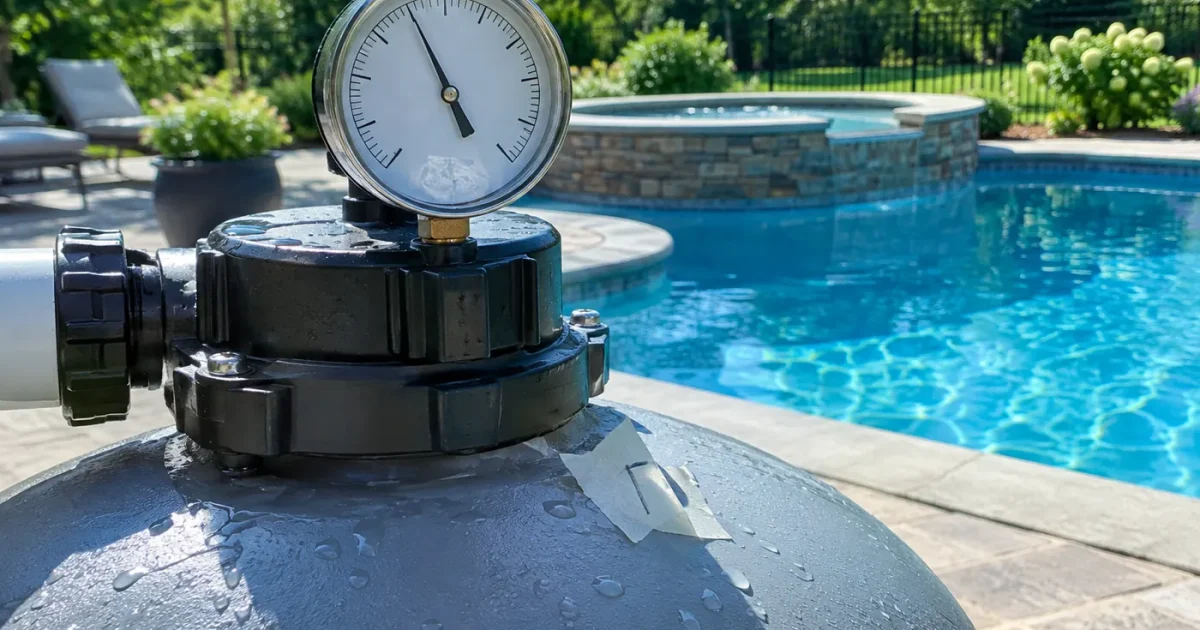
- Bad gauge A reading with the pump off, a stuck needle, or a fogged face.
- Know your clean pressureNoted right after a backwash or cleaning, at the same pump speed
- Read the gauge nowPump running, valve on Filter
- Compare the twoAbove clean, or below it?
- 8 to 10 psi above clean?
Yes: backwash a sand or DE filter, or hose off the cartridges. If it stays high after that, see steps 6 to 9.
No, it is below clean: the problem is before the filter. Check baskets, water level, valves and prime in steps 2 to 5.
Step-by-step: fix pool filter pressure that is too high or too low
Pool filter pressure only means something next to your own clean pressure. Hayward and Pentair both tell you to write that number down, because it changes with the pump and the plumbing. Do these steps in order. The first ones are free.
- Record your clean pressure. Hayward says to note the gauge reading when the filter is clean, since it varies from pool to pool. Pentair calls it the “Original Starting Pressure” and has a space in its manual to record it. With a variable speed pump, Pentair says that pressure depends on pump speed, so also note the RPM. Comparing readings at different speeds will fool you.
- Test the gauge. Turn the pump off and open the air relief valve. Pentair says to replace the gauge if it does not read zero with the pressure off, if it reads wrong while running, or if it is hard to read or damaged. A bad gauge can send you chasing a problem that is not there.
- Empty the skimmer and pump baskets. Full baskets starve the pump and pull the filter pressure down. Hayward lists dirty baskets first for low water flow, and Pentair lists clogged baskets when pressure drops at the gauge.
- Check water level and valves. If the water is so low that the skimmer gulps air, top up the pool. Make sure the suction and return valves are open and the multiport handle sits fully on Filter. A closed or half-closed return valve pushes pressure up, and a closed suction valve pulls it down.
- Look for air and lost prime. Hayward says bubbles coming back into the pool point to an air leak in the suction line. Look at the pump lid: a strainer pot that is not full of water means the pump is losing prime. A pump with no prime moves little water, so the gauge reads near zero. Our pool pump not priming guide covers that fix.
- Clean the filter at the right point. Hayward says to backwash its sand and DE filters when the gauge reads 8 to 10 psi above clean. Pentair says to clean its cartridge filter at about 10 psi above the starting pressure, or when flow drops a lot. Backwash until the sight glass or waste water runs clear, then Rinse, then back to Filter. A DE filter needs fresh DE after every backwash.
- If sand pressure stays high after backwashing. Hayward says the sand bed may be clogged with mineral deposits that will not backwash out, and that some calcium-based chlorines can add to this. Its first fix is to remove about the top inch of sand and replace it with the same amount. If that fails, ask a Hayward dealer about a filter cleaner, or replace the sand.
- If cartridge pressure stays high after hosing. Pentair says to hose each cartridge at a 45-degree angle, top to bottom, working between the pleats. If pressure is still high, an acid soak may help: first remove oils and cleaners from the cartridge, then follow Pentair’s mix and wear gloves, eye protection and a mask. If pressure stays high after the soak, Pentair says replace the cartridges.
- If DE pressure climbs fast after backwashing. Hayward says minerals and oils can coat the grids. It recommends cleaning them once a year or each season with a degreaser, with an acid bath if needed, and rinsing with a hose, not a power washer. Too little DE at pre-coat lets dirt embed in the fabric. If cleaning does not work, Hayward says the grids need replacing.
- Check the water itself. Hayward lists algae as a cause of short filter cycles and says to balance chlorine and pH. Hayward also notes that a very dirty pool may need frequent backwashing during the first clean-up. See green pool water for that process.
- Check pump and filter sizing. If pressure has been high since new equipment went in, the pump may be too big for the filter. Hayward says a pump over the filter’s maximum flow causes high back pressure and can make sand channel, so dirt slips past. A pump under 60% of the filter’s design flow will not backwash it fully. The filter label lists its flow rates.
Stop. Never let the gauge reach 50 psi. Hayward says never to run or test the system above 50 psi, and Pentair lists 50 psi as its cartridge filter’s maximum working pressure. Turn the pump off before you move the multiport handle, and bleed the air relief valve to zero before you open the tank. When mixing acid, add the acid to the water, never water to acid, and never mix it with chlorine.
| What the gauge shows | Likely cause | Next step |
|---|---|---|
| 8 to 10 psi above clean, weak flow | Dirty filter | Step 6 |
| Still high right after cleaning | Clogged sand, cartridge or grids | Steps 7 to 9 |
| High ever since a new pump went in | Pump too big for filter | Step 11 |
| Below clean, weak flow, bubbles | Blockage or air leak before filter | Steps 3 to 5 |
| Zero with pump running | Lost prime, stalled pump or bad gauge | Steps 2 and 5 |
Sand vs cartridge vs DE pressure
All three filters follow the same rule: clean when pressure rises about 8 to 10 psi over clean. What differs is how you clean and what is left to try when pressure will not come down.
Sand (Hayward ProSeries). Backwash about 2 minutes or less until the sight glass is clear, then Rinse for about 1/2 to 1 minute. If it stays high, the top inch of sand comes out first, then the whole bed.
Cartridge (Pentair Clean and Clear Plus). No backwash. Pull the cartridges and hose them. If that fails, acid soak, then replace.
DE (Hayward Pro-Grid). Backwash about 2 minutes, Rinse about 20 seconds, then add fresh DE. Your new clean pressure is the reading after the DE goes in. Hayward says a backwash removes only about 80 to 90% of the DE, so the grids also need a periodic hand cleaning.
Low flow from a dirty filter can also trip a heater or heat pump flow switch. If yours shows a flow error, see pool heat pump error E3. For parts and specs for each filter type, see our pool filter problems hub.
When to call a pool or spa pro
- Pressure stays high after a full cleaning and you have ruled out a closed return valve.
- Sand or DE shows up in the pool along with pressure changes.
- The gauge ever reads near 50 psi.
- The pump will not hold prime after you have fixed the lid O-ring and water level.
- Pressure jumped after new equipment went in and you suspect a pump and filter mismatch.
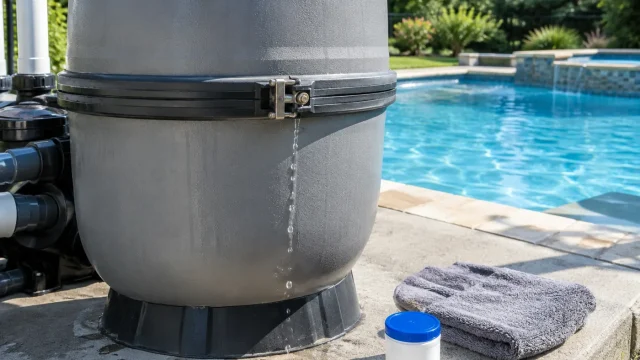
- Pressure drops and the filter starts leaking at the same time. See pool filter leaking first.
Common questions
What pressure should a pool filter run at?
There is no single right number. Each pool has its own clean pressure, set by the pump, the pipes and the filter. Write yours down right after a backwash or cleaning, then clean again when it rises about 8 to 10 psi above that.
Is 20 PSI too high for a pool filter?
Not by itself. If your clean pressure is 12 psi, then 20 psi means it is time to clean, but if your clean pressure is 18 psi, 20 is fine. The same goes for 15, 25 or 30 psi. The hard limit is 50 psi, which Hayward and Pentair say never to reach.
Is 5 PSI too low for a pool pump?
It depends on your clean pressure. If your filter normally reads 15 psi when clean and now reads 5, less water is reaching it. Check the baskets, the water level, the suction valve and the pump’s prime.
Why does my pool filter read 0 PSI?
With the pump running, zero usually means the pump has lost prime or is not moving water, or the gauge is broken. Look in the pump lid: if the strainer pot is not full of water, fix the prime. If water is moving well at the jets, replace the gauge, which Pentair says to do when it reads wrong.
What would cause low pressure in my pool filter?
Low pressure means less water is reaching the filter. Hayward lists dirty skimmer and pump baskets, blocked suction lines and air leaks in the suction line, which show up as bubbles at the return jets. Low water in the skimmer and a closed suction valve do the same.
Why is my filter pressure still high after backwashing?
For a sand filter, Hayward says the sand may be clogged with minerals that will not backwash out, a return valve may be partly closed, or the pump may be the wrong size for the filter. Try removing the top inch of sand before you replace the whole bed. For a DE filter, the grids may need a degreaser and acid cleaning.