Common symptoms
- The water has a green tint or has gone fully green, even though the chlorinator shows it is running.
- Your test shows little or no free chlorine with the output set at its usual level.
- A Check Salt, Low Salt, Inspect Cell, No Flow or cold water light is on or flashing.
- Walls and steps feel slippery, and green shows first in corners and on steps.
- The pool turned green after a hot spell, a big storm, a party, or a few weeks of shorter pump runs.
Quick checks before anything else
- The chlorinator is switched on, set to Auto (not Off), and the output is not at 0%.
- The pump actually runs long enough each day. No pump, no chlorine.
- No warning lights for salt, flow, cell or water temperature.
- Free chlorine and salt, tested with your own kit or meter. Do not trust the display alone.
- pH and stabilizer (CYA) tested the same day.
- The water is warm enough for your cell to run.
Why is my saltwater pool turning green?
- Salt too low Every system slows or stops making chlorine below its salt limit, and Jandy lists salt under 3,000 ppm (parts per million) as a cause of low chlorine.
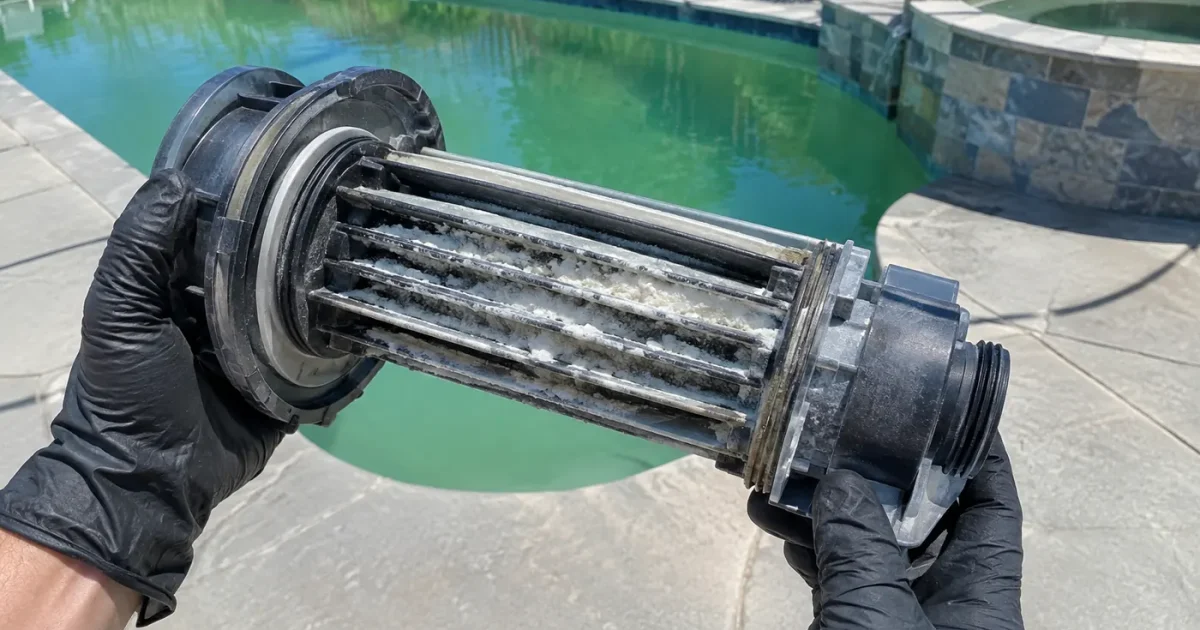
- Scaled cell White crust between the plates cuts output and can throw off the salt reading.
- Too few pump hours or output too low The cell only works while water flows, and demand rises in hot weather.
- Cold water Hayward, Pentair and Jandy cells slow down or shut off in cool water early and late in the season.
- Low stabilizer or high pH Without CYA the sun burns off chlorine, and Jandy says chlorine works less well when pH is out of range.
- Chlorine eaters Pentair says nitrates and phosphates can drain chlorine, and metals can cause chlorine loss and damage the cell.
Step-by-step: clearing a green salt pool and fixing the cause
A salt water pool turning green needs two fixes at once: kill the algae now, then find out why the cell fell behind. The cell alone rarely catches up with a green pool, so we shock first and troubleshoot while the shock works. For amounts, follow the product label and our pool calculator.
- Test with your own kit. Test free chlorine, pH, CYA and salt yourself. Taylor, a test kit maker, warns that automatic salt readings can be wrong, especially when the cell has scale. Hayward says its display should be within 500 ppm of an independent salt test.
- Shock the pool now. Turn on the system’s boost or super chlorinate mode: Hayward, Pentair and Jandy all run the cell at full output for up to 24 hours. Pentair says a high chlorine demand can outrun the cell, and both Pentair and Jandy say that if chlorine is still low after boost, you should super chlorinate from an outside source such as liquid chlorine. Brush the walls and floor every day, as LaMotte advises for algae. Our green pool water guide covers the full shock and brush routine.
- Bring pH into range. Jandy says chlorine does not work as well when pH is out of range, which raises chlorine demand. Its ideal is 7.4 to 7.6. Taylor says salt cells make sodium hydroxide, which pushes pH up, so salt pools need acid often. If pH keeps climbing, read pool pH that won’t go down.
- Check salt against your own system’s range. Hayward’s AquaRite aims for 2,700 to 3,400 ppm, with 3,200 best. Pentair’s IntelliChlor shows good salt from 2,800 to 4,500 ppm. Jandy’s TruClear wants 3,000 to 3,500 ppm. Add salt by your maker’s chart if you are low. Pentair says to switch its cell off before adding salt or balancing chemicals, then allow 24 hours for the salt to mix.
- Check pump hours and output. Hayward lists a filter time under 8 hours a day for an average pool as a cause of little or no chlorine, and explains that 50% output means the cell runs half the time the pump runs. Pentair suggests starting with a 12-hour pump timer and 60% output, then adjusting every 24 hours. Pentair and Hayward both say to raise output in hot weather and with more swimmers.
- Check water temperature. Hayward cuts output back at 60°F and stops at 50°F. Pentair shuts off at 52°F, plus or minus 3°F. Jandy says running below 55°F is not recommended. In cool water, add chlorine by hand until it warms up; Hayward says you can override its cold cutoff by switching to super chlorinate for a day.
- Inspect and clean the cell. Turn off power at the breaker first. Remove the cell and hold it up to a light. Jandy says if light passes easily between the plates, it does not need cleaning. If scale blocks the light, rinse with a hose first, then acid wash by your maker’s mix: Hayward uses 4 parts water to 1 part muriatic acid, Pentair 1 quart of acid in 1 gallon of water, and Jandy 1 part acid to 10 parts water for no more than 30 minutes. Keep the wire end out of the acid.
- Clear any No Flow light. Jandy lists a dirty filter, closed valves, poor pump flow and a loose cell connection as causes. Clean the baskets and filter and check that valves are open. Hayward says its flow switch needs at least 12 inches of straight pipe before it.
- Test stabilizer. Hayward, Pentair and Jandy all call for 30 to 50 ppm of CYA outdoors. Pentair says the sun’s UV destroys 90% of unstabilized chlorine within two hours.
- Test for nitrates, phosphates and metals. Pentair says nitrates should not exceed 10 ppm and phosphates should stay under 125 ppb (parts per billion), and that copper and iron can cause chlorine loss and damage the cell. A pool store or lab can test these. Our guide on pool chlorine that keeps dropping goes deeper on chlorine eaters.
- Filter out the dead algae. Run the pump and clean the filter as pressure rises. The water often turns cloudy once the algae dies, which is normal; see pool cloudy after shock if it lingers.
Stop. Turn off power to the chlorinator at the breaker before you remove the cell. Wear goggles and rubber gloves, mix acid outdoors, and always add acid to water. Never mix acid with chlorine. If the breaker or GFCI (ground fault circuit interrupter, the safety device that cuts power on a shock risk) keeps tripping, stop and call an electrician.
Hayward vs Pentair vs Jandy: what differs when a salt pool turns green
These figures come from one owner’s manual for each brand. Your model may differ, so check its own manual and label.
| Item | Hayward AquaRite | Pentair IntelliChlor | Jandy TruClear |
|---|---|---|---|
| Salt range | 2,700 to 3,400 ppm; 3,200 best | Good at 2,800 to 4,500 ppm | 3,000 to 3,500 ppm |
| Low salt | Warning at 2,400 to 2,700; stops at 2,300 or less | Reduced output below 2,800; off below 2,600 | Warning well below 2,500 |
| Cold water | Cut back at 60°F; stops at 50°F | Off at 52°F, plus or minus 3°F | Not recommended below 55°F |
| Shock mode | Super Chlorinate, 24 hours | Boost, 24 hours of pump time | Boost, 24 hours |
| Cell check | Every 3 months; reminder at about 500 hours | Every 2 months if it tends to scale | Every month |
The biggest trap is salt. A reading that is perfect on one brand can be too high or too low on another, so use your own system’s number, not a friend’s or a pool store’s general figure. The rest of the salt system checks are in our salt water pool problems hub.
When to call a pool or spa pro
- The cell is clean, salt is right, and chlorine still stays low with the output turned up. Hayward says an Inspect Cell light that stays on after a good cleaning can mean a worn cell.
- A board error, blown fuse, blank display or tripping breaker.
- Salt is far too high. The only fix is draining part of the water, and draining can damage some pools.
- Nitrates or metals show up in a test.
- The pool is still green after several days of shocking, brushing and filtering.
Common questions
How do I fix my green saltwater pool?
Shock it, brush it and filter it, the same as any green pool, then fix the cause. Use boost or super chlorinate mode and add liquid chlorine if the cell cannot keep up. Then check salt, pump hours, output, water temperature, CYA and the cell for scale.
Does shock get rid of green algae?
Yes, a chlorine shock does when free chlorine goes high enough and stays there while you brush. LaMotte’s treatment for green algae is to check pH, shock and brush, then repeat as needed. A non-chlorine shock does not raise free chlorine, so it will not kill algae.
Can a pool go from green to clear overnight?
Rarely. Shock can kill the algae in a day, but the filter still has to remove it, and the water often turns cloudy first. LaMotte notes that algae can take daily brushing and several treatments.
How long does it take to get green algae out of a pool?
None of the makers give a set time, because it depends on how green the pool is and how well the filter keeps up. Plan on several days of shocking, brushing and filtering, and keep testing until free chlorine holds.
What can ruin a salt water pool?
Running the cell with too little salt, letting scale build on the plates, and running it in cold water all shorten cell life, says Jandy, which also warns that too much acid washing damages the cell. Hayward and Pentair warn that dry acid used in dry regions can leave by-products that damage the cell. Jandy says salt above 4,500 ppm may cause corrosion.
Is it safe to swim in a pool that has turned green?
No. Green water means chlorine is too low to protect swimmers, and murky water hides anyone in trouble. Wait until the water is clear and free chlorine is back to at least 2 ppm, CDC’s minimum for pools with stabilizer, and no higher than 4 ppm, the safe level LaMotte gives after a shock.