Common symptoms
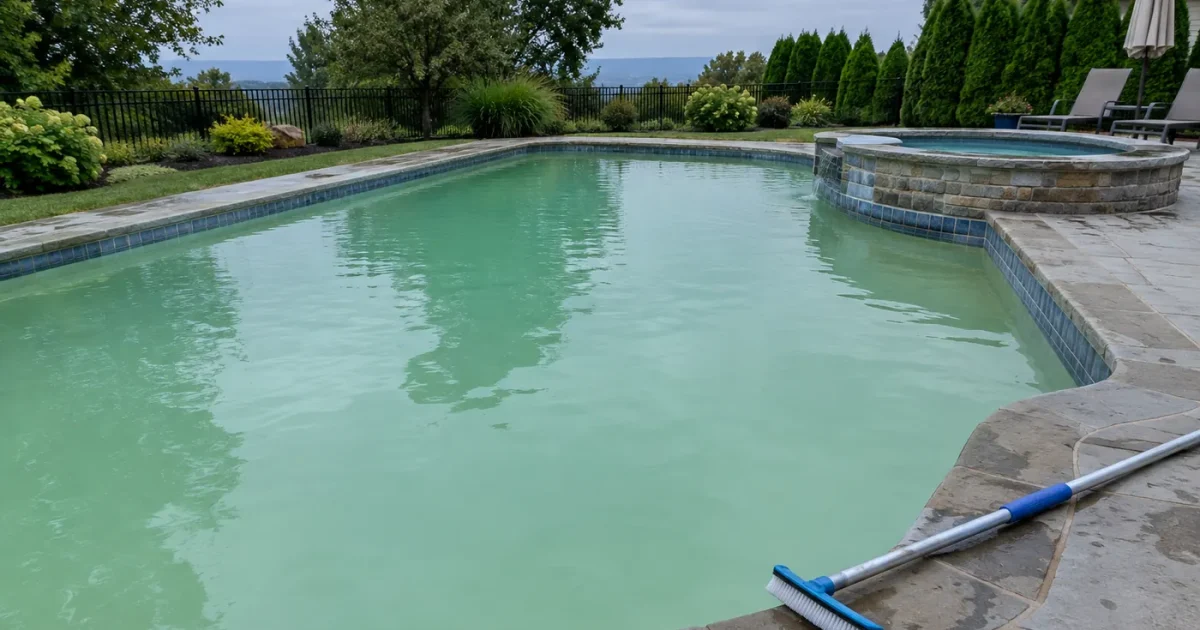
- The water looks hazy or milky with a light green tint.
- You can see the floor in the shallow end but not the deep end drain.
- Steps and corners feel slippery.
- Free chlorine is low, or it drops fast after you add some.
- After a shock, the green faded but the water turned cloudy blue-green or gray.
- Filter pressure rises quickly and the filter needs cleaning more often than usual.
Quick checks before anything else
- The pump runs and the return jets push a strong flow.
- The filter gauge is within 8 to 10 psi of its clean reading.
- Free chlorine, pH and CYA are tested, not guessed.
- Chlorine reading checked for bleach-out if you shocked recently.
- You know whether the haze came before or after your last shock.
- Nothing else was added in the last day, such as a clarifier or algaecide.
What does cloudy green water mean?
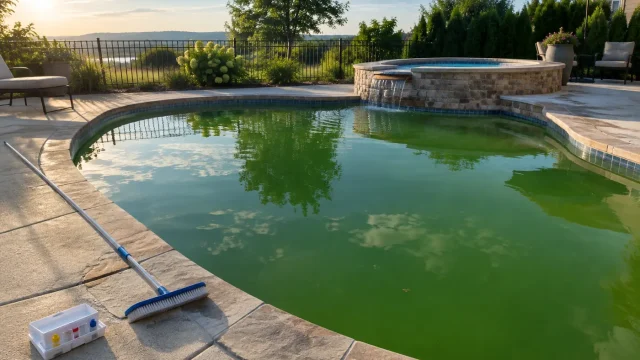
Cloudy green water is usually algae, either growing or dying. LaMotte’s cloudy water chart lists “hazy pool water with slightly green appearance” under algae growth, and notes that green algae can make a pool especially cloudy. Metals color water too, but metal-tinted water stays see-through in the early stages, so haze points to algae.
- Algae taking hold Free chlorine slipped low, so the water hazes over and gets greener by the day.
- Dead algae after a shock The green fades to a cloudy blue-green or gray while the filter catches up.
- A filter that cannot keep up Hayward notes algae can clog a filter and keep pressure high, and live algae can grow faster than a filter removes it.
- High pH LaMotte lists cloudy, turbid water and weak chlorine as signs of high pH. A cal-hypo shock label says to lower pH before shocking to help avoid clouding.
- Too much stabilizer Cyanuric acid (CYA) slows chlorine, so algae can grow even with chlorine in the water. LaMotte also lists high CYA among the unbalanced water causes of cloudy water.
- Shock to the target levelSee step 5 for the level
- Wait a few hours with the pump onBrush while you wait
- Retest free chlorineDilute the sample if it reads over 10 ppm
- Is chlorine still high and the green fading?
Yes: the algae is dying. Focus on the filter, brushing and vacuuming.
No: the algae is still using up chlorine. Add more, keep brushing and test again.
Step-by-step: how to clear cloudy green pool water
We treat this as two jobs: kill the algae, then filter out what is left. Hayward notes that chlorine makes algae inactive, and then the filter has to remove it. Our green and cloudy pool water hub has the full set of target numbers.
- Keep everyone out. CDC says to avoid unusually cloudy water, because cloudiness can be a warning that there are more germs in the water than normal. CDC also tells swimmers to make sure they can see the drain at the bottom of the deep end.
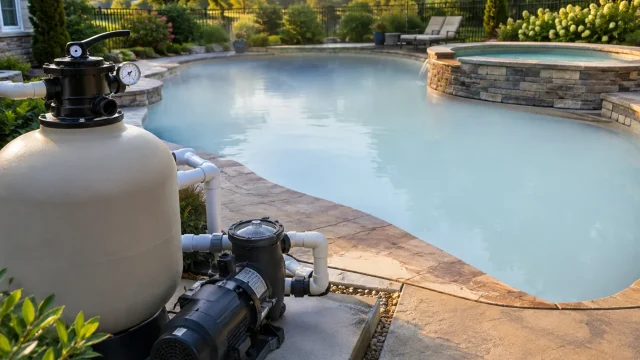
- Clean the filter and run it nonstop. Backwash a sand or DE filter, or hose off a cartridge, then note the clean pressure. Hayward says to backwash when the gauge reads 8 to 10 psi above that number. LaMotte’s fix for poor filtration includes running the filter for 24 hours.
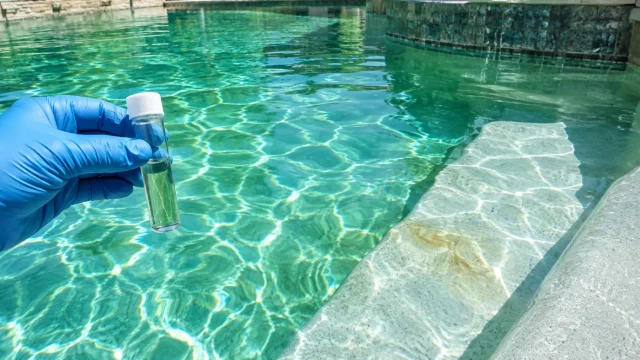
- Test free chlorine, pH and CYA. Free chlorine is the chlorine still able to kill algae, measured in ppm (parts per million). If CYA is far above the 30 to 50 ppm ideal, chlorine will work slowly, and Taylor says lowering it usually takes a partial drain.
- Lower pH before you shock. One cal-hypo shock label asks for pH between 7.2 and 7.4 before shocking, both to help avoid clouding and to help the product disperse. Add acid as its label directs, with the pump running. Our pool calculator works out doses for your pool’s size.
- Superchlorinate with unstabilized chlorine. For hazy water with a slight green look, LaMotte says to superchlorinate to 30 ppm and brush the pool surfaces. Hayward’s advice for a green bloom is unstabilized granular chlorine or liquid chlorine. Add it at night or when the pool is not in use, as the cal-hypo label says.
- Brush the whole pool. Brush walls, floor, steps and behind ladders and lights. Algae hides on surfaces, and brushing lets chlorine reach it. LaMotte says daily brushing and several treatments may be needed.
- Retest and top up. Test again a few hours later. Above 10 ppm the DPD test can bleach out and read falsely low, so Taylor says to dilute the sample, retest and multiply (by 2 for a 1:1 dilution). If chlorine is falling fast, add more and keep brushing. If it keeps vanishing for days, read pool chlorine keeps dropping.
- Clean the filter every time pressure climbs. Dead algae loads the filter fast. Clean it again each time the gauge rises 8 to 10 psi over the clean reading. LaMotte names poor filtration as one of the usual causes of cloudy water.
- Vacuum what settles. Hayward says to set a multiport valve to Waste when vacuuming heavy debris, so it goes out of the pool instead of back through the filter. Add fresh water afterward to bring the level back up.
- Add a clarifier only if haze lingers. LaMotte says repeated treatments or a clarifier may be recommended if cloudiness persists. A clarifier clumps tiny particles so the filter can catch them. HTH’s directions say never to add clarifier and shock at the same time, and not to backwash or clean the filter for at least 24 hours after adding it.
- Check the rest of the balance. If the water stays hazy with good chlorine and a clean filter, test calcium hardness, alkalinity and total dissolved solids (TDS). LaMotte lists high calcium hardness, TDS and CYA as causes of cloudy water, and its fix is to replace part of the water with fresh water.
- Keep it from coming back. LaMotte says keeping at least 2.0 ppm of free chlorine at all times is the best way to avoid algae. Hayward’s sand filter manual says to run the pump long enough each day for at least one turnover, which means all the water passes through the filter once.
Stop. Never mix shock with acid, clarifier or any other chemical, and never add water to a dry shock product. A cal-hypo shock label warns that mixing could cause a fire or explosion. Add one product at a time with the pump running.
Liquid chlorine vs cal-hypo vs dichlor for a cloudy green pool
All three raise free chlorine. They differ in what else they leave in the water, and that matters when the water is already cloudy.
| Shock type | Product pH (LaMotte) | What else it adds |
|---|---|---|
| Liquid chlorine (sodium hypochlorite) | 13.0 | No calcium, no CYA; pushes pH up |
| Cal-hypo (calcium hypochlorite) | 11.8 | Calcium; raises pH, so lower pH first |
| Dichlor | 6.0 | CYA: 6 to 7 ppm per pound in 10,000 gallons (Taylor) |
For a cloudy green pool, we lean toward liquid chlorine. It adds no calcium and no CYA, while cal-hypo adds calcium and can cloud water at high pH, and dichlor raises CYA, which makes the next round of algae harder to kill. If you use cal-hypo, fix pH first, as its label says. Whichever you pick, size the dose for 30 ppm with the calculator, follow the label’s handling rules and keep the pump running.
When to call a pool or spa pro
- Chlorine will not hold even after several days of shocking and brushing.
- CYA, calcium or TDS is so high that part of the water must be replaced.
- The filter pressure stays high right after cleaning, or sand or DE blows into the pool. Our pool filter problems hub covers those faults.
- The pump loses prime or runs but moves little water.
- Black spots on the walls keep coming back after brushing and shocking.
Common questions
How can I clear up a cloudy green pool?
Clean the filter, lower pH to about 7.2 to 7.4, then superchlorinate with unstabilized chlorine and brush, with the filter running nonstop. LaMotte gives 30 ppm as the target for hazy, slightly green water. Keep cleaning the filter and vacuuming until the haze is gone.
How long does it take for a pool to clear up that’s green and cloudy?
No maker gives a fixed time, because it depends on how much algae there is and how well your filter keeps up. LaMotte notes that daily brushing and several treatments may be needed. Plan on a few days, and expect the last of the haze to take longest.
Why is my pool water cloudy or murky green tinted?
Murky green water is usually algae. LaMotte notes that a turbid green pool is usually algae, while green from metals stays see-through early on. Low chlorine, high pH, high CYA or short pump runs let it grow.
Why is my pool still cloudy and green even after shocking it?
Either the shock was not strong enough to kill all the algae, or the algae is dead and the filter has not removed it yet. Retest chlorine: if it fell fast, add more and brush. If chlorine is holding, clean the filter, vacuum and keep it running. For haze that shows up right after a shock in clear water, see cloudy pool water.
How to clear a green pool in 24 hours?
A light green, hazy pool with a clean filter can clear quickly, but no official source promises 24 hours. The fastest path is the same: correct pH, shock hard with unstabilized chlorine, brush, and run and clean the filter. For a dark green pool, start with our guide to green pool water.