Common symptoms
- The motor runs, but the strainer pot stays empty or only half fills with water.
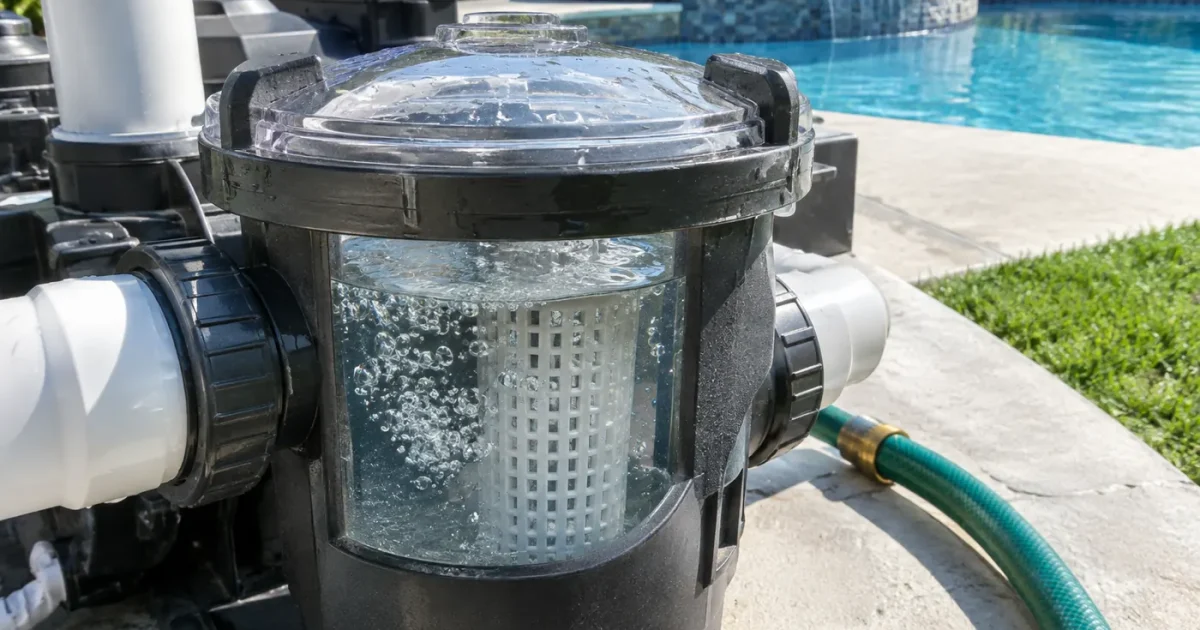
- Air bubbles swirl in the pot under the clear lid.
- Bubbles spit out of the return jets in the pool wall.
- The pump primes, then loses it after a few minutes or overnight.
- Flow at the returns is weak, and the filter gauge reads lower than usual.
- The pump sounds louder or rattly.
Quick checks before anything else
- Pool water is at least halfway up the skimmer opening.
- Every suction and return valve is open.
- The skimmer basket and the pump basket are empty and not cracked.
- The strainer pot is filled with water before you start the pump.
- The lid O-ring is clean, lubricated, sitting in its groove, and the lid is hand-tight.
- The air relief valve on top of the filter is open when you start the pump.
- Both drain plugs are back in the pump if it was winterized.
What makes a pool pump lose prime?
Prime means the pump and the suction pipe are full of water, so the pump can pull more water behind it. A self-priming pump can lift water from below, but only when the pot starts full and no air gets in. Hayward puts it plainly: any self-priming pump will not prime if there are suction air leaks.
- Lid O-ring leak A dry, cracked or twisted O-ring, or one dirt grain on the seat, lets air in at the top of the pot. This is the first thing Hayward checks.
- Suction-side air leak Loose unions, threaded fittings, valve stems or drain plugs before the pump. The sign is bubbles at the return jets.
- Low water level The skimmer gulps air once the water drops too low. Pentair warns the pump then loses prime and runs dry.
- Clog A packed skimmer or pump basket, a blocked suction line, or debris in the impeller starves the pump of water.
- Not enough water to start An empty pot, or a pump mounted more than about 10 feet above the water.
- Priming setting too low On variable-speed pumps, a priming speed or time set too low for your plumbing.
- Pump off, valves closedRelease pressure at the filter air relief valve
- Fill the potWater up to the suction pipe
- Seal the lidClean, lubed O-ring, hand-tight
- Open valves and air reliefStand clear, then start the pump
- Full of water within your manual’s time limit?
Yes: close the air relief valve once a steady stream of water, not air, comes out.
No: stop the pump and work through the steps below to find the air leak or clog.
Step-by-step: getting a pool pump to prime and stay primed
We go from the free checks to the ones that need a gauge or a pro. Turn the pump off at the breaker before you open anything.
- Raise the water level. Pentair says to keep the water about halfway up the skimmer opening. If it falls below, the skimmer pulls air, the pump loses prime and runs dry, and the shaft seal gets damaged. Top the pool up with a garden hose before you try again.
- Open every valve. Hayward says all suction and return valves must be open while the pump runs, and the filter valve must be set to send water back to the pool. Only change valve positions with the pump off.
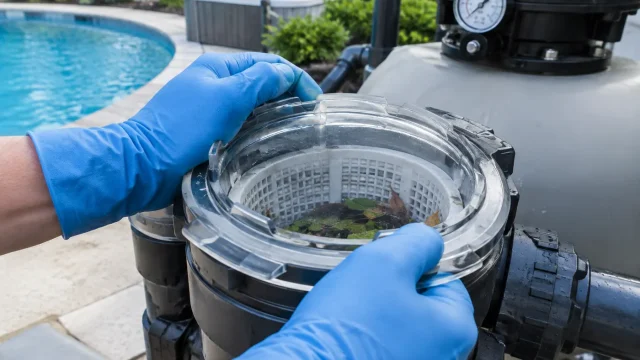
- Empty both baskets. Clean the skimmer basket, then the basket in the pump pot. Hayward says not to strike the basket to clean it. On Pentair pumps, line up the notch in the bottom of the basket with the rib in the pot when you put it back. Replace a cracked basket.
- Fill the pot and seal the lid. Hayward’s routine: stop the pump, close the valves, release pressure at the filter’s air relief valve, take off the lid, and fill the pot with water up to the suction pipe. Clean the O-ring, check it for cracks, lube it with the lubricant your manual names (Hayward specifies Jack’s 327), and seat it in its groove. Tighten the lid by hand only. If it is stuck, see pool pump lid won’t open.
- Start it the safe way. Open the valves again and open the air relief valve on top of the filter. Hayward says to stand at least 10 feet from the pump and filter at startup. When a steady stream of water, not air or spitting air and water, comes out of the air relief valve, close it.
- Give it time, but not too much. Hayward says its Super Pump can take up to 10 minutes to prime, but if it has not primed in 5, stop the motor and find the cause. Priming time grows with the height and length of the suction pipe. See the table below for other models. Never let it run dry for long: water cools and lubricates the shaft seal.
- Hunt for suction air leaks. Bubbles at the return jets mean air is getting in before the pump, per Hayward. Check every union, threaded fitting, valve stem and drain plug between the skimmer and the pump, and any hose clamps. Hayward’s fixes: tighten unions, reseal threaded joints with PTFE tape, and repair or replace valves whose O-rings or packing glands (the seals around the valve handle stem) leak.
- Test the suction for a clog. With the skimmer full and the pump running, take out the skimmer basket and hold a flat object over the bottom port, as Hayward’s Super Pump VS manual describes. If you feel no pull, the line may be blocked. A pool tech can confirm with a vacuum gauge at the strainer lid: Hayward expects 5 to 6 inches of vacuum. Hayward sends a clogged suction line to a qualified pro.
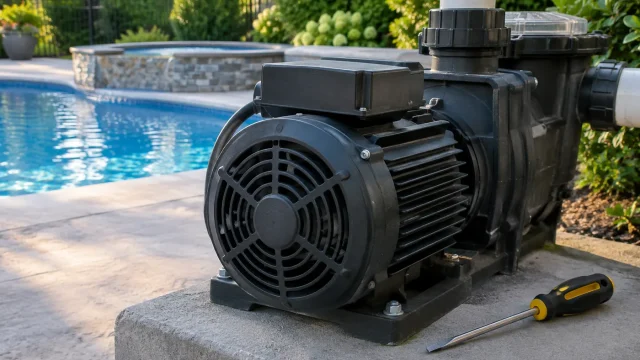
- Check the impeller. If the pot has water but the pump will not pull a vacuum, Hayward says to check for debris in the impeller and confirm the motor is getting full voltage. A jammed or clogged impeller also shows up as a pump that hums; see pool pump humming but not running.
- Adjust variable-speed priming. Pentair’s IntelliFlo3 troubleshooting lists “priming speed or range too low” and says to adjust the priming settings until the pump primes every time. On the Hayward Super Pump VS, you can set priming at maximum speed for 0 to 15 minutes in 30-second steps.
- Check the pump height and speed. Hayward’s two-speed motors only self-prime on high speed, so start them on high. If your pump sits more than 10 feet above the water, it is outside what Hayward, Pentair and Jandy list for their pumps.
Stop. Never open the strainer pot on a pump that failed to prime or ran dry while it is hot. Pentair warns it can build vapor pressure and hold scalding water. Open the valves, wait until the pot is cool to the touch, then open it with care. If water leaks from the pump or filter when you fill the pot, Hayward says do not start the pump.
Hayward vs Pentair vs Jandy: priming numbers
The method is the same on all three brands, but the limits differ, so check the manual for your model.
| Model | Height above water | Priming time |
|---|---|---|
| Hayward Super Pump (single and two-speed) | Self-priming to 10 ft; two-speed on high only | Up to 10 minutes; stop if not primed in 5 |
| Hayward Super Pump VS | See manual | Up to 10 minutes; stop if not primed in 10. Prime time settable from 0 to 15 minutes; the manual’s menu shows 8 |
| Pentair SuperFlo | Install no more than 10 ft above the water | Fill the pot before starting |
| Pentair IntelliFlo3 VSF | See manual | Default maximum priming time 11 minutes; never run over 30 minutes without priming |
| Jandy VS FloPro | Certified to prime up to 10 ft at sea level | About 14 to 15 minutes at the default 2,750 RPM at 10 ft; within 6 minutes at 3,450 RPM |
Pentair adds one rule for pumps below the pool’s water level: close the suction and return lines before you open the pot, and open them again before you start. For the rest of the pump system, see our pool pump problems hub.
When to call a pool or spa pro
- You see bubbles at the returns but cannot find the leak at any fitting you can reach.
- The skimmer test shows no suction, which points to a blocked suction line.
- The pump primes only when someone holds a hose in the skimmer.
- Water drips under the pump between the motor and the pump body (a worn shaft seal).
- The pump ran dry for a long time and now leaks or squeals.
Common questions
What would cause a pool pump to lose prime?
Air getting in on the suction side is the usual cause: a dry or cracked lid O-ring, a loose union or valve, a missing drain plug, or low water that lets the skimmer pull air. Clogged baskets or a blocked suction line can also starve the pump. If the filter gauge reads high while flow is weak, the filter is the problem; see pool filter pressure too high or too low.
How to clear airlock in pool pump?
Turn the pump off, close the valves, and fill the strainer pot with water. Reseal the lid, open the valves and the air relief valve on top of the filter, then start the pump while you stand clear. Close the air relief valve when a steady stream of water comes out, as Hayward and Pentair both direct.
How long should a pool pump take to prime?
It depends on the model and how far the pump sits above the water. Hayward says its Super Pump may take up to 10 minutes, but to stop and find the cause if it has not primed in 5. Pentair’s IntelliFlo3 defaults to an 11-minute priming limit, and Jandy’s VS FloPro can need about 14 to 15 minutes at its default priming speed when it sits 10 feet above the water.
Why won’t my pool pump fully prime?
A pot that stays partly full of air while the motor runs means air is still getting in, or not enough water is reaching the pump. Check the lid O-ring first, then the suction fittings and valves, then the water level and baskets. On a variable-speed pump, a priming speed set too low can also leave air in the pot.
Is it bad to run a pool pump with air bubbles?
Yes, if it goes on for long. Pentair warns that a pump drawing air loses prime and runs dry, which damages the shaft seal, and that continued running can damage the pump case and impeller. Hayward also links air leaks to low flow and a noisy pump.
How to get prime back on pool pump?
Turn the pump off, refill the strainer pot, check the lid O-ring, and restart with the filter’s air relief valve open. If it lost prime while you were vacuuming, the hose likely let air in. Hayward’s suction cleaner manual says to fill the hose completely with water before you connect it to the skimmer, and the same habit helps with a manual vacuum. Vacuuming can also stir up dust, which our guide to a pool that turns cloudy after vacuuming covers.