Common symptoms
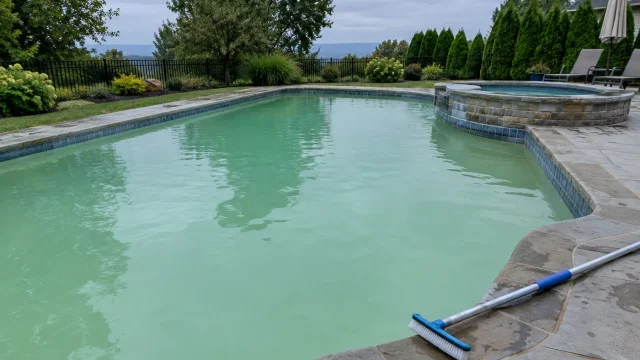
- The water looks white, milky or dull instead of sparkling.
- You can see the shallow end floor but the deep end drain is fuzzy or gone.
- Fine dust settles on the floor overnight.
- A white crust forms at the tile line or on steps.
- The water smells strongly of chlorine, or swimmers complain of red eyes.
- The haze appeared after heavy rain, a pollen storm, a party or a shock.
Quick checks before anything else
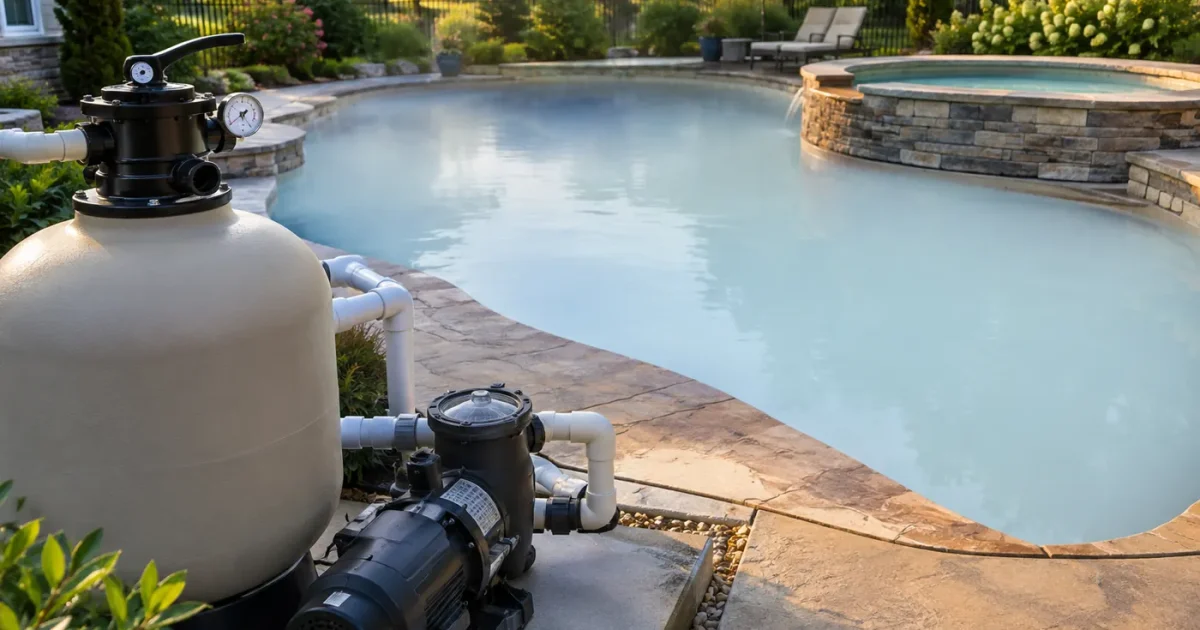
- The pump runs long enough each day for at least one full turnover.
- The filter valve is set to Filter, not Recirculate.
- The filter gauge is within 8 to 10 psi of its clean reading.
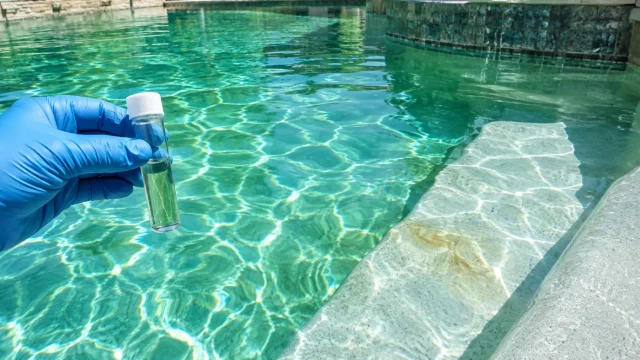
- Free chlorine and pH are tested with an in-date kit.
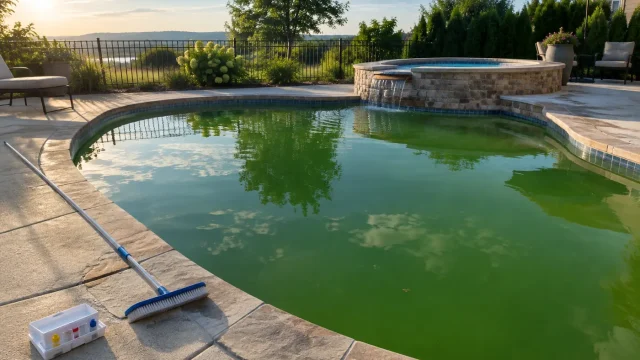
- No tint of green: if there is one, it is likely algae.
- No sand or DE powder is collecting near the return jets.
What makes pool water cloudy?
LaMotte, a test kit maker, says the usual causes of cloudy pool water are poor filtration and unbalanced water, and that algae or a severe chloramine problem can cloud it too. We check them in that order, because the filter is the cheapest to fix.
- Poor filtration A dirty filter, worn media or a pump that runs too few hours leaves fine particles in the water.
- High pH or alkalinity LaMotte lists cloudy, turbid water among the signs of high pH, and says to look for high pH and alkalinity when water clouds.
- High calcium hardness or TDS LaMotte says too much hardness clouds water before scale forms, and that high total dissolved solids (TDS) can cloud it too.
- Low chlorine or chloramines Chloramines (combined chlorine) are chlorine that has reacted with sweat and other waste. They smell strong and LaMotte links a severe case to cloudy water.
- Early algae A slight green look with the haze means algae is starting.
- Rain, pollen and debris Hayward notes heavy rain, wind-blown debris, leaves, pollen and dust all bring particles into the water.
Step-by-step: what to fix first
Do these in order. Each step is cheaper than the next, and an early cause, like a filter that is too dirty, can make every chemical fix look like it failed. Our green and cloudy pool water hub has all the target numbers in one table.
- Keep swimmers out if you cannot see the bottom. CDC says to make sure you can see the drain at the bottom of the deep end, and to avoid unusually cloudy water because it can be a warning of more germs than normal.
- Check pump run time. Turnover is the time it takes for all the water to pass through the filter once. Hayward says to run the system long enough for at least one complete turnover each day, and LaMotte suggests a turnover every six hours in busy pools. If you cut run time to save power, raise it while you clear the water.
- Clean the filter. Hayward says to backwash a sand or DE filter at 8 to 10 psi above its clean pressure. Pentair says to clean its Clean and Clear Plus cartridge at about 10 psi over the starting pressure, or when flow drops noticeably. Record the clean pressure afterward. Our pool filter pressure guide explains readings that are too high or too low.
- Look at the filter media. LaMotte says to check sand for gaps or hard spots and notes sand generally needs replacing every 3 to 5 years. For DE grids, it says to hose them off and inspect for damage. For cartridges, swap in a clean one and clean the dirty one. Hayward’s sand filter chart also says to check the sand surface for crusting and remove about 1 inch if needed.
- Test free and total chlorine. Free chlorine is the chlorine still able to kill germs, measured in ppm (parts per million). Total minus free is combined chlorine. LaMotte says to shock when combined chlorine reaches 0.2 ppm or more. If free chlorine is near zero, shock too, because algae is likely on the way.
- Test pH and total alkalinity. LaMotte’s fix for this kind of cloudy water is acid to bring pH to 7.2 to 7.6 and alkalinity to 80 to 120 ppm. Add acid in small doses with the pump running, and use our pool calculator for the amount. If pH keeps climbing back, see pool pH won’t go down.
- Test calcium hardness, CYA and TDS. LaMotte’s ideal calcium hardness is 200 to 400 ppm, and it says to keep TDS under 2,000 ppm. LaMotte also lists high cyanuric acid (CYA, the stabilizer) among the causes of cloudy water. When any of these is too high, its fix is replacing part of the water with fresh water low in hardness and TDS.
- Run the filter for 24 hours. LaMotte’s treatment for poor filtration includes running the filter for 24 hours. Brush the walls and floor first so settled dust gets picked up, and empty the skimmer baskets as they fill.
- Use a clarifier or flocculant if haze stays. LaMotte notes repeated treatments or a clarifier may be recommended when cloudiness persists. The next section explains which one to choose.
- Vacuum the floor. Fine debris that settles needs to come out. Hayward says to set a multiport valve to Waste for heavy debris so it leaves the pool instead of going back through the filter. If you vacuum through the filter, clean it right after.
Stop. Never add clarifier, shock and acid together. HTH’s clarifier directions say never to mix clarifier and shock or add them at the same time, and a cal-hypo shock label warns that mixing chemicals could cause a fire or explosion. Add one product, let it circulate, then test before the next.
Clarifier vs flocculant: which one to use
Both clump tiny particles together. The difference is where the clumps go, and that decides which one your pool can use.
Clarifier. A clarifier makes particles clump so the filter can catch them. It suits light to medium haze and any filter. HTH’s directions say to dilute it in a bucket of pool water, pour it around the pool, and run the filter at least 8 hours. Do not backwash or clean the filter for at least 24 hours after adding it, so the clumps stay trapped.
Flocculant (floc). A floc makes particles clump and sink to the floor, where you vacuum them out. It works on heavy haze but takes more work. HTH’s floc directions say to balance pH to 7.2 to 7.6 first, run the pump 2 hours, then turn it off and let the pool settle overnight (8 to 12 hours). Then vacuum slowly to waste, because vacuuming through the filter sends the particles back into the pool. HTH notes that most above-ground pool filter systems have no vacuum-to-waste option, so a clarifier is the better choice there. Nobody swims while the floc is settling.
| What you notice | Likely cause | Next step |
|---|---|---|
| Haze with high filter pressure | Dirty filter | Steps 3 and 4 |
| Haze, strong chlorine smell, red eyes | Chloramines | Step 5 |
| Haze with pH over 7.8 | High pH or alkalinity | Step 6 |
| Haze plus white crust at the tile line | High calcium | Step 7 |
| Haze with a green tint | Early algae | Shock and brush |
If the haze has a green tint, our guide to cloudy green pool water covers the algae side. If it showed up right after you vacuumed, start with pool cloudy after vacuuming.
When to call a pool or spa pro
- The filter pressure is high again right after cleaning, or never rises at all.
- Sand or DE powder is coming back into the pool.
- Calcium, CYA or TDS is high enough that part of the water needs replacing.
- The water stays cloudy after every step above. LaMotte says to consult a pool professional when cloudiness persists.
- White scale is building on surfaces or inside the heater.
Common questions
Why is my pool cloudy but chlorine is high?
High chlorine with cloudy water usually points to the filter or the water balance, not a lack of sanitizer. Check the filter and pump run time, then test pH, alkalinity, calcium and CYA. Also check whether chlorine was added recently: one cal-hypo label says to lower pH before shocking to help avoid clouding. If the haze came right after a shock, see pool cloudy after shock.
Do I add more chlorine if my pool is cloudy?
Only if the test says so. Add chlorine if free chlorine is low or combined chlorine is 0.2 ppm or more, since LaMotte says that calls for a shock. If chlorine is already in range, more will not clear the haze; fix the filter and balance instead.
What is the fastest way to clear up a cloudy pool?
Clean the filter, correct pH and chlorine, and run the filter around the clock. If the haze stays, add a clarifier, or use a floc if you can vacuum to waste. A floc settles particles overnight, but you then have to vacuum them out and top up the water.
Will baking soda clear up a cloudy pool?
No. Baking soda (sodium bicarbonate) raises total alkalinity, and Taylor notes it also raises pH slightly. Since high pH and alkalinity are causes of cloudy water, baking soda can make haze worse unless your alkalinity is actually below 80 ppm.
Will a cloudy pool clear on its own?
Rarely. Haze clears only when the filter catches it, and that will not happen with a dirty filter, short pump runs or water out of balance. Fix the cause first, then let the filter work.
Is it safe to swim in a cloudy pool?
Not if you cannot see the drain at the bottom of the deep end. CDC says to make sure the drain is visible and to avoid unusually cloudy water, because it can mean more germs than normal. Wait until the water is clear and chlorine and pH are back in range.