Common symptoms
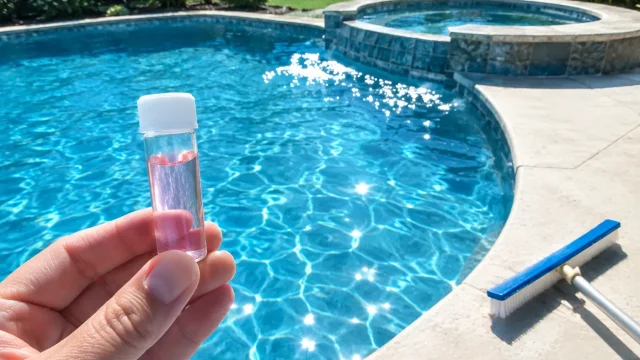
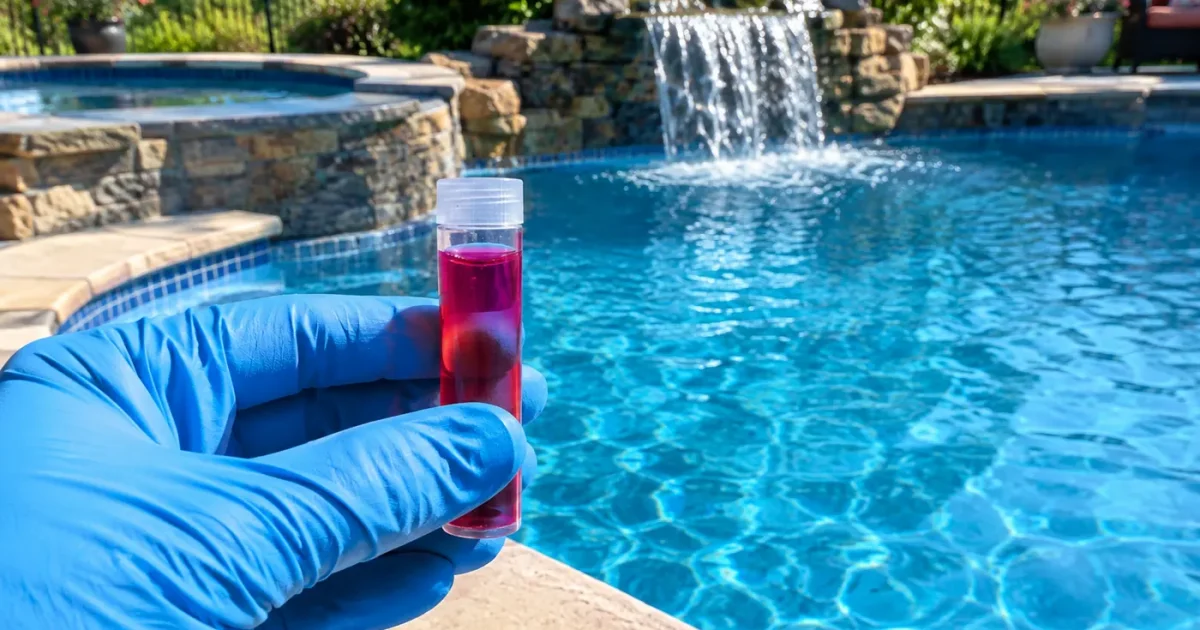
- The pH test reads 7.8, 8.0 or the darkest color on the kit, even after you added acid.
- pH drops after a dose of acid, then creeps back up within a few days.
- The total alkalinity test reads above 120 ppm (parts per million).
- The water looks a little hazy, and a white crust builds at the tile line or on the salt cell.
- Chlorine seems weak even though you add the usual amount, and swimmers’ eyes sting.
Quick checks before anything else
- The pH reading is real: chlorine was under 10 ppm when you tested, and the reagents are in date.
- You tested total alkalinity (TA) the same day as pH.
- You know your cyanuric acid (CYA) level, because it inflates the TA reading.
- You know what feeds your pool chlorine: liquid chlorine, cal-hypo, trichlor tablets or a salt cell.
- Waterfalls, spillovers, bubblers or jets that splash the surface are turned off while you work on pH.
- You know whether the plaster is new or was redone in the last six months.
Why does pool pH keep rising?
- High total alkalinity TA is the water’s buffer. LaMotte, a test kit maker, says high TA makes a high pH hard to adjust, so it fights every dose of acid.
- Basic chlorine LaMotte lists liquid chlorine at pH 13.0 and cal-hypo at 11.8. Every dose nudges the pool’s pH up.
- A salt chlorinator Taylor, another test kit maker, says the salt-to-chlorine reaction makes sodium hydroxide, which pushes pH up in salt pools.
- Splashing and jets LaMotte notes that jets force carbon dioxide out of the water, and that this raises pH.
- New plaster Jandy’s salt system manual says new plaster pools have a constant acid demand for six months.
- A false reading Taylor says chlorine above 10 ppm can throw off the pH test, and CYA adds to the TA reading.
Step-by-step: getting pH down and keeping it there
pH that won’t stay down is almost always an alkalinity problem, not an acid problem. We lower TA first, then fine-tune pH, then remove what keeps pushing it back up. Use your acid’s label and our pool calculator for amounts, since the right dose depends on your gallons and your TA.
- Confirm the pH reading. Do not test right after a shock; LaMotte says to wait. Taylor says chlorine above 10 ppm interferes with the pH test and can push the color toward purple, so a high-chlorine pool can read high when it is not. Use fresh reagents. LaMotte says phenol red, the usual pH indicator, measures only from 6.8 to 8.4, so a reading at the darkest color on your kit can mean pH is even higher.
- Test TA and correct it for CYA. Taylor and LaMotte both say CYA shows up in the alkalinity test. Subtract one third of your CYA reading from your TA reading to get the true number. For example, TA of 100 ppm with CYA of 60 ppm is really 80 ppm.
- Lower TA first if it is high. Taylor’s ideal TA is 80 to 120 ppm, with 180 ppm as its maximum. Taylor says to correct TA first and retest after each change, because the acid that lowers TA also lowers pH. LaMotte’s acid charts note that higher alkalinity takes more acid. Add it in steps, not one big dose.
- Add acid safely. Pentair’s IntelliChlor manual says to use muriatic acid to lower pH. The safety data sheet for Hasa’s muriatic acid warns that it causes severe skin burns and eye damage and may irritate the lungs, and says to wear gloves and eye protection and work outdoors or in good air. Run the pump, add acid slowly by the label, and keep it away from chlorine. The same sheet says never to mix it with chlorine bleaches.
- Wait, then retest. Let the pump run so the acid mixes through the whole pool before you test again. Write down pH and TA each time. If pH bounces up within a day or two while TA is still above 120, keep working TA down in small steps.
- Cut the splashing while you work. Turn off waterfalls, spillovers, fountains and air bubblers until pH settles. LaMotte explains the jet effect in spas: jets force carbon dioxide out, and pH rises. We see waterfalls and spillovers as the same kind of cause, since they churn the surface too.
- Look at your chlorine source. Liquid chlorine and cal-hypo are strongly basic, and trichlor (pH 3.0 on LaMotte’s chart) is acidic. LaMotte’s TA target matches: 80 to 120 ppm for pools on liquid chlorine or cal-hypo, and 100 to 150 ppm for pools on trichlor or dichlor. A pool on liquid chlorine will need acid on a regular basis. That is normal, not a fault.
- Salt pools: test pH more often. Taylor recommends testing pH daily in pools with a salt chlorinator, and says the units tend to keep pH steadier when TA is between 90 and 100 ppm. Hayward and Pentair discourage dry acid with their salt cells in dry regions, because by-products can build up and damage the cell. Our salt water pool problems hub covers the rest.
- New plaster: expect acid demand. Jandy says new plaster pools have a constant acid demand for six months, and to test often. Follow your plasterer’s start-up instructions over any general advice, including ours.
- Test your fill water. LaMotte says make-up water can range from pH 5.0 to 8.0. If you top off often, fill a clean glass from the hose and test its pH and TA. Water that comes in high keeps pushing the pool back up.
Stop. Never pour acid and chlorine into the pool at the same time or from the same scoop or bucket. CDC warns that pool chemicals can hurt people when mixed. If you dilute acid, always add acid to water, never water to acid, and keep swimmers out while you dose.
| What you see | Likely cause | Next step |
|---|---|---|
| pH and TA both high | Overbuffered water | Steps 2 and 3 |
| pH high, TA in range, pool has a waterfall | Splashing drives pH up | Step 6 |
| pH climbs a little every day in a salt pool | Sodium hydroxide from the cell | Step 8 |
| pH test turns purple | Chlorine above 10 ppm | Step 1 |
| New or resurfaced plaster | Plaster curing | Step 9 |
Muriatic acid vs dry acid: which lowers pH better?
Both work. LaMotte names muriatic acid (liquid hydrochloric acid) and dry acid (sodium bisulfate) as the two ways to meet an acid demand, which is the amount of acid the water needs to reach your target pH. The differences are in handling and what they leave behind.
- Muriatic acid. Liquid, fast, and what Pentair and Jandy name for lowering pH in salt pools. It gives off fumes, so open it outdoors and stand upwind.
- Dry acid. Granules that are easier to store and measure. Hayward and Pentair warn against it in salt pools in dry regions, where water is rarely diluted, because its by-products can build up and damage the cell.
Whichever you choose, use one product at a time and follow its label. A small pool and a large one need very different amounts, so measure your gallons first.
When to call a pool or spa pro
- pH is still above 7.8 after several careful rounds of lowering TA.
- White scale is building on tile, the salt cell or the heater.
- Your acid feeder or pH controller reads wrong or doses too much or too little.
- The pool was plastered recently and the builder has a specific start-up plan.
- You are not comfortable handling muriatic acid.
For how pH, TA, CYA and calcium fit together, see our pool chemistry hub. High pH also makes chlorine work poorly, so if chlorine vanishes too, read pool chlorine keeps dropping. If the water has turned hazy, our cloudy pool water guide picks up from here.
Common questions
Why is my pool pH constantly high?
Usually because something adds to it every day while high alkalinity resists your acid. Liquid chlorine, cal-hypo and salt cells all push pH up, and splashing from waterfalls or jets drives it up too. Lower TA toward 80 to 120 ppm and the rise slows down.
Will pool pH go down on its own?
Not in most pools fed by liquid chlorine, cal-hypo or a salt cell, because those push pH up. Pools on trichlor tablets tend to drift down, since trichlor is acidic. If yours is high, plan to lower it with acid.
How to fix high alkalinity and high pH in pool?
Lower alkalinity first with muriatic acid in small doses, retesting between each one, because acid lowers both TA and pH. Once TA is in range, fine-tune pH. Taylor says to correct TA first and retest after every change.
Is it okay to swim in a pool with high pH and alkalinity?
We would wait until pH is back in CDC’s range of 7.0 to 7.8. CDC says chlorine kills germs less well as pH rises, especially above 8.0, and LaMotte lists eye irritation as a sign of high pH. Also wait until the acid you added has fully mixed in.
Can you shock a pool if pH is too high?
You can, but the shock works poorly at high pH, so lower pH first. One HTH shock label says to adjust pH first and let the pH adjuster dissolve and disperse before adding the shock. Never add acid and shock at the same time.
Why is my pH high but alkalinity low?
Low TA means weak buffering, so pH swings with every chemical you add. Taylor calls this “pH bounce.” A dose of liquid chlorine or cal-hypo can push pH high, and then a small dose of acid can crash it. Raise TA into the 80 to 120 ppm range first, then set pH.