Common symptoms
- The motor hums or buzzes, but the cooling fan at the back of the motor does not turn.
- No water moves. The basket in the strainer pot sits still and the return jets go quiet.
- The motor hums for a while, clicks off, and later tries again on its own.
- The breaker trips or a fuse blows each time the pump tries to start.
- The motor case is very hot to the touch, or you smell something hot.
Quick checks before anything else
- Turn the pump off at the breaker. Do not leave it sitting there humming.
- Check that the breaker, the GFCI (ground-fault circuit interrupter, the outlet or breaker with test and reset buttons) and the timer are all on.
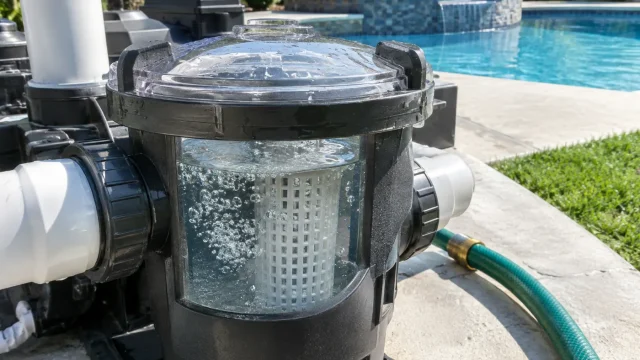
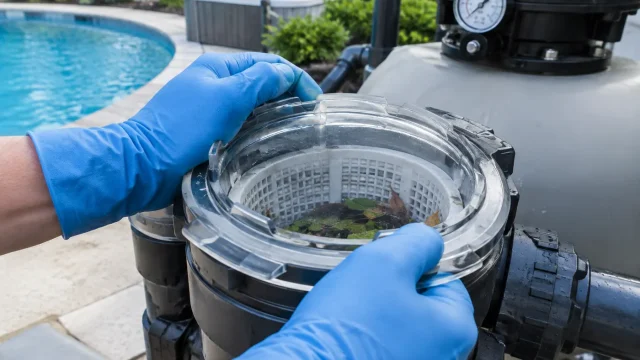
- Look through the clear lid. Is the basket packed with leaves, or is the pot empty of water?
- If the motor case is hot, let it cool before you test anything.
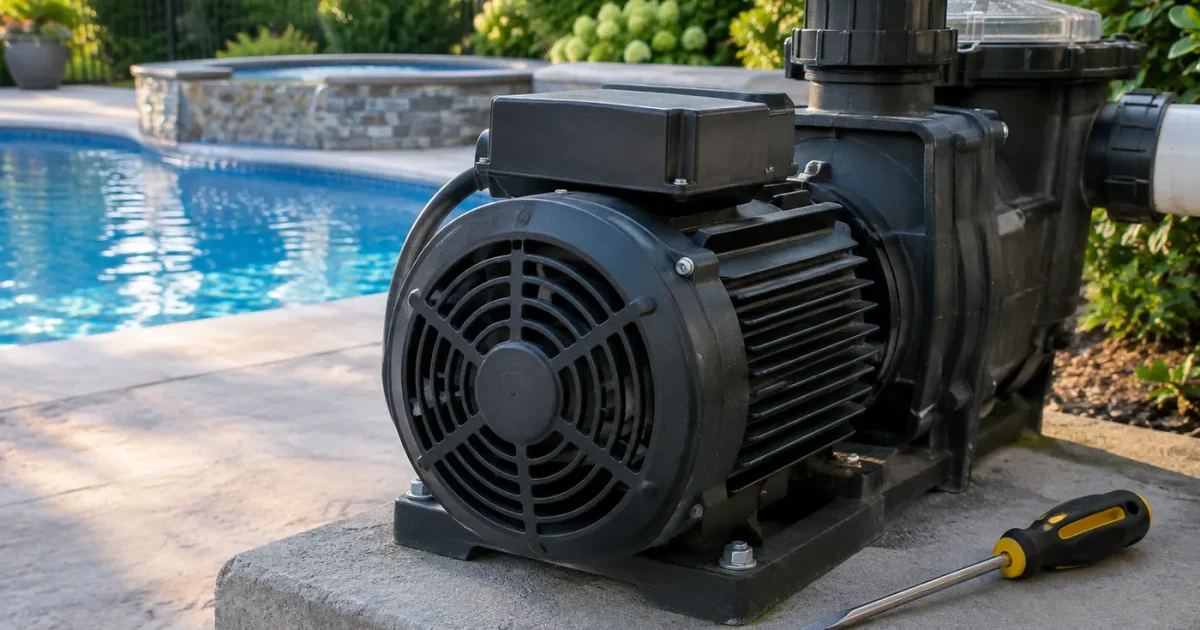
- With the breaker off, try to turn the motor shaft by hand at the back of the motor.
- Read the pump label: single-speed, two-speed or variable-speed. The checks differ.
Why does a pool pump hum but not run?
A hum means power is reaching the motor, but the shaft is not turning. Either something is holding the shaft, or the motor cannot make enough force to start it.
- Jammed impeller A pebble, seed pod or wad of hair wedges the impeller (the small plastic fan wheel that moves the water). It is the one cause Hayward lists for a motor that hums but will not start.
- Failed start capacitor On many single-speed motors, a capacitor gives the motor its kick at startup. When it fails, the motor hums and the shaft sits still. A.O. Smith says a bulged capacitor means failure on most motors.
- Low voltage Thin wiring, a long run or an extension cord drops the voltage, so the motor cannot get going. Hayward and A.O. Smith both want voltage within 10% of the nameplate rating.
- Seized or worn bearings The shaft feels stiff or grinds by hand. Hayward links whining bearings to a leaking shaft seal that lets chlorinated water wash out the bearing grease.
- Bad start switch Some motors have a centrifugal start switch (a spring-loaded switch inside the motor that cuts out the start circuit once the shaft spins up). Dirty or stuck contacts stop the motor from starting.
- Overheated motor The thermal overload (a built-in heat switch) cuts the motor off when it gets too hot and lets it restart once it cools, so you hear it try again and again.
- Breaker offWait for the motor to cool
- Check the potFull basket, no water, debris
- Turn the shaft by handAt the back of the motor
- Does it spin freely?
Yes: the problem is likely electrical: voltage, the capacitor or the start switch (steps 7 to 9).
No: the problem is mechanical: a jammed impeller or seized bearings (steps 5 and 6).
Step-by-step: fixing a pool pump that hums but won’t start
We go from free, safe checks to jobs that need a meter or a motor shop. Every step starts with the power off at the breaker.
- Cut the power and let it cool. Switch the pump off at the breaker; the timer alone is not enough. Hayward’s Super Pump VS manual and Pentair’s IntelliFlo3 guide both say to let the motor cool for 20 minutes before you service it, to avoid burns. A.O. Smith adds a test: if the motor was hot, let it cool to air temperature and then turn the power back on. If it starts and then shuts down again, it is overloading, and a pro should check the voltage and current draw (step 7).
- Check the breaker, GFCI and timer. Hayward’s list for a motor that will not start begins with tripped breakers, tripped GFCIs, blown fuses, open switches or relays, and loose wiring. It also says to make sure the timer works and to bypass it if needed. If a GFCI trips again right after you reset it, leave it off and call an electrician.
- Look in the strainer pot. Look for a packed basket or an empty pot. If the pump ran dry, Pentair warns the pot can hold pressure and scalding water: open the valves and wait until the pot is cool to the touch before you open it. If the lid fights you, see how to get a stuck pump lid off safely.
- Turn the shaft by hand. The shaft end sits at the back of the motor, under the fan cover. Depending on the motor, Hayward’s manual grips it with a flat-blade screwdriver, a 1/4 inch hex driver or a 7/16 inch wrench through the fan shroud; some motors need an end cap removed first. A healthy shaft turns smoothly. Stuck or grinding: go to step 5. Free: skip to step 7.
- Clear a jammed impeller. Hayward says to have a qualified repair professional open the pump and remove the debris. Pentair’s manual describes the job for owners: power off, take the pump apart, and clean the debris off the impeller. Check the strainer basket while you are there. Pentair says to replace a cracked basket, and a crack lets debris reach the impeller again.
- Check for seized bearings. If the shaft still grinds with the impeller clear, the trouble is inside the motor. A.O. Smith’s checks for grinding are the bearings, a rotor rubbing the stator, corrosion, a cracked frame and a clogged fan. A drip between the motor and the pump body means a worn shaft seal, and Hayward says to replace leaking seals at once before they ruin the bearings.
- Measure the voltage while it tries to start. This needs a meter and live power, so call an electrician or pool tech. A.O. Smith reads the voltage at the motor terminals as the motor tries to start. For a 230 volt motor, Hayward’s 10% rule means about 207 to 253 volts. Low readings point to undersized wiring, an overloaded circuit or a burned start winding. Hayward also names extension cords.
- Check the start capacitor. This is the small canister on the side or top of many single-speed motors. A.O. Smith’s method: power off, remove the capacitor, discharge it by laying an insulated screwdriver across its terminals, then test it with an ohmmeter. If you have never done this, hand it to a pro. Order the replacement by your exact motor: Hayward even splits the capacitor for one Super Pump model by build date.
- Have the start switch looked at. If voltage and capacitor test good, A.O. Smith points to the start switch inside the motor: dirty contacts, or a governor (the part on the shaft that works the switch) that sticks. That is motor shop work.
- Restart the right way. Fill the strainer pot with water, close the lid hand-tight, open all valves and the air relief valve on top of the filter, stand clear and turn the power on. Hayward says to wait 5 seconds between stopping and restarting, or the motor can spin backward. If the motor runs but the pot will not fill, see our pool pump not priming guide.
Stop. Never spin a humming shaft with the power on, and never touch capacitor terminals until the capacitor is discharged. Pentair’s SuperFlo and WhisperFlo manuals say never to open the drive or motor enclosure, because a capacitor bank inside holds a 230 volt charge even with no power to the unit. The WhisperFlo manual also says to wait at least 60 seconds after power-off before servicing.
Single-speed vs variable-speed pumps (Hayward, Pentair, Jandy)
Single-speed and two-speed motors. These are the classic hummers. Hayward’s Super Pump 700 parts list includes a capacitor set, and A.O. Smith sells capacitor-start, split-phase and capacitor-start/capacitor-run motors. Some also have a start switch, though A.O. Smith’s Centurion line has none. Steps 4 to 9 all apply.
Variable-speed pumps. The Hayward Super Pump VS, Pentair IntelliFlo3 and Jandy VS FloPro run from an electronic drive. Hayward’s Super Pump VS uses a permanent magnet motor, and Pentair’s IntelliFlo3 has an internal cutoff that stops the motor if it gets too hot. Drive problems usually show as an alarm on the display, so look the code up in your manual first. A jammed impeller still stops these pumps: Hayward’s Super Pump VS manual gives the same “impeller jammed with debris” answer for a hum with no start.
Parts rarely swap between brands or models, so write down the model number from the pump label and motor nameplate before you order. For how the whole pump works, see our pool pump problems hub. Above-ground filter pumps differ; see Intex or Bestway pool pump not working. A humming spa pump is covered in hot tub pump not working or humming.
When to call a pool or spa pro
- The shaft will not turn and you do not want to open the pump.
- The breaker or GFCI trips again right after a reset.
- You need a voltage reading under load, or the motor is on an extension cord.
- The capacitor looks bulged or leaks, and you have never discharged one.
- The shaft grinds, or water drips from between the motor and the pump body.
- A variable-speed pump shows an alarm that the manual says needs service.
Common questions
My pool pump hums but isn’t pumping water. What could be the problem?
If the shaft is not turning, the usual causes are a jammed impeller, a failed start capacitor, low voltage or seized bearings. With the power off, try the shaft by hand: stuck means a mechanical problem, free means an electrical one. If the motor runs but moves no water, the pump has likely lost prime instead.
How to tell if a pool pump motor is burned out?
A motor is likely done when good voltage reaches it, the capacitor tests fine, the impeller is clear, and it still hums or trips the breaker. A burnt smell and grinding bearings point the same way. A.O. Smith also lists a winding check for damage or shorts, which a motor shop can do before you buy a new motor.
My pool pump is hot and not running. What could be causing this?
Most likely the thermal overload has cut the motor off to protect it. Hayward says the motor restarts once it cools and keeps cycling until you fix the cause. A.O. Smith lists low voltage, blocked motor vents, and an impeller that rubs or a seal that binds.
Is there a reset button on my pool pump?
Hayward and A.O. Smith single-speed motors use an automatic overload with no button: it resets itself once the motor cools, and the breaker, GFCI and timer are the other places to reset. Variable-speed pumps have their own keypad and alarm steps, so follow your model’s manual.
My pool pump breaker won’t reset. What can I do?
Leave it off and call an electrician. A breaker that trips the moment you reset it, or as soon as the motor hums, points to a stalled motor or a short. With the power off, you can still check whether the shaft turns by hand, which tells the electrician where to start.