Common symptoms
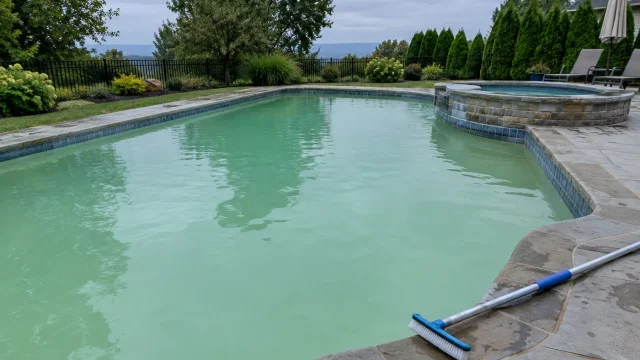
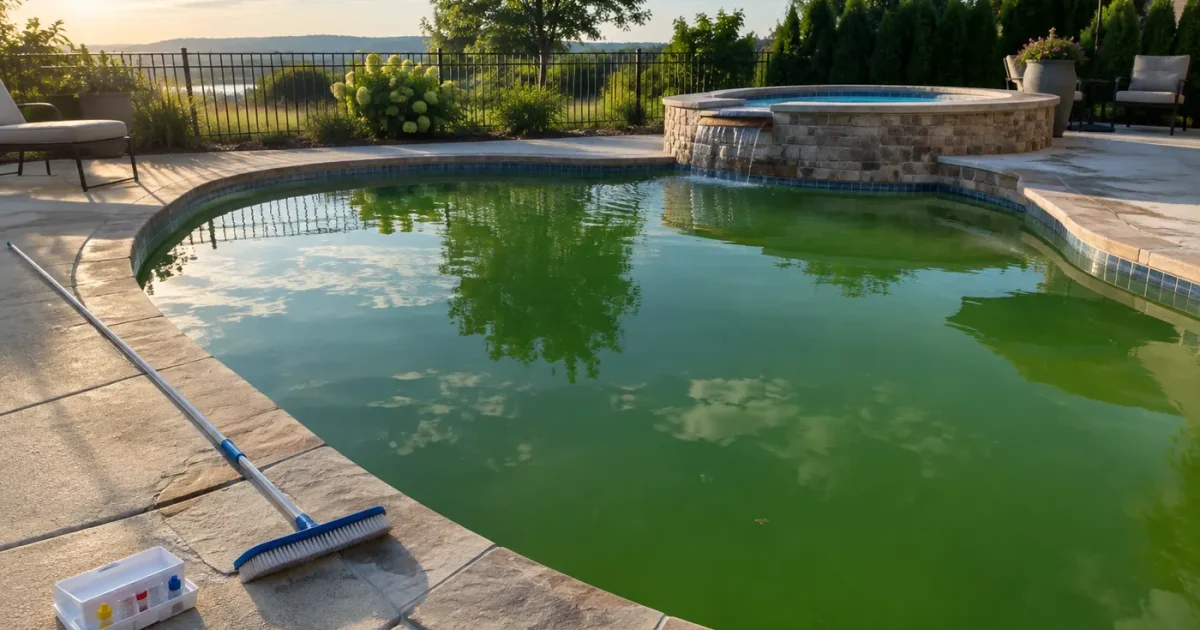
- The water has a green tint, anywhere from a light haze to a murky pea-soup color.
- You cannot see the drain at the bottom of the deep end.
- Walls, steps and corners feel slimy or slippery.
- Free chlorine tests at or near zero.
- Filter pressure climbs fast and the return jets push less water.
- The color showed up quickly, often after hot weather, a storm or a few days with the pump off.
Quick checks before anything else
- The pump is running and water is flowing out of the return jets.
- The skimmer and pump baskets are empty.
- The filter gauge is not 8 to 10 psi above its clean reading.
- Free chlorine and pH are tested with an in-date kit.
- You have looked into the deep end: murky green, or clear but tinted?
- You know whether the color appeared right after a shock or a fill from a well.
Why does a pool turn green?
- Low free chlorine Free chlorine is the chlorine still able to kill germs and algae, measured in ppm (parts per million). Hayward notes that under the right conditions, algae can turn a pool completely green in just a few hours.
- High pH LaMotte says a pH above 7.8 keeps chlorine from working well and lets algae grow, even when there is chlorine in the water.
- Too much stabilizer Cyanuric acid (CYA) shields chlorine from the sun, but CDC research shows it also slows chlorine down. Taylor puts the ideal range at 30 to 50 ppm.
- Short pump runs or a dirty filter Hayward says to run the pump long enough for at least one turnover a day (all the water passing through the filter once).
- Algae food LaMotte calls phosphate and nitrate the building blocks of algae and suggests keeping phosphate under 100 ppb and nitrate under 10 ppm.
- Metals, not algae Green water that stays see-through usually comes from iron or copper, often right after a shock.
- Look into the deep endMurky and hard to see through, or clear with a tint
- Feel the wallsSlime on steps and corners points to algae
- Test free chlorine and pHNear-zero chlorine feeds algae
- Murky green, slimy walls, low chlorine?
Yes: it is algae. Follow the steps below.
No: clear, tinted water with normal chlorine points to metals. Test for copper and iron before adding more chlorine.
Step-by-step: how to fix a green pool
We work from the cheapest, safest steps to the chemicals. The order matters: shocking a pool with a clogged filter or high pH wastes chlorine, and shocking a pool full of metals can stain it. Our green and cloudy pool water hub has the full list of target numbers.
- Keep everyone out. CDC tells swimmers to make sure they can see the drain at the bottom of the deep end, and green water fails that test. Algae also means chlorine is too low to protect against germs. Nobody swims until the water is clear and free chlorine is back down to a safe level.
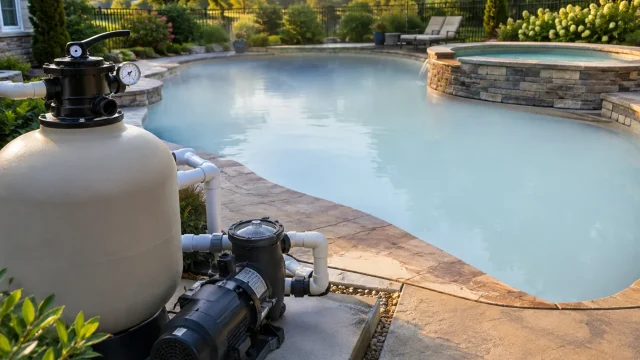
- Get the water moving. Scoop out leaves with a net, empty the skimmer and pump baskets, and set the filter valve to Filter. Run the pump around the clock while you treat. If the pump will not run or the jets barely push water, fix that first, because chemicals cannot spread or filter out without flow.
- Clean the filter before you shock. Hayward says to backwash a sand or DE filter when the gauge reads 8 to 10 psi above its clean starting pressure. Pentair says to clean its Clean and Clear Plus cartridge filter at about 10 psi above the starting pressure. Write down the clean reading after you finish, so you know when it needs cleaning again.
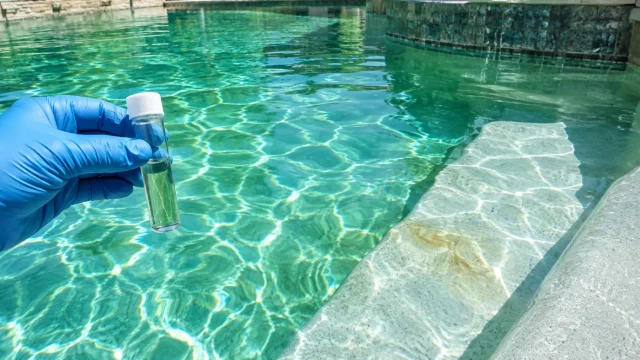
- Test free chlorine, pH and CYA. CDC notes test strips are less accurate than a DPD drop kit (the kind that turns pink with chlorine). If CYA is far above 50 ppm, chlorine will work slowly, and Taylor says the usual fix is a partial drain plus a switch to unstabilized chlorine.
- Bring pH into range. LaMotte’s algae treatment starts with checking and adjusting pH. One cal-hypo shock label asks for pH between 7.2 and 7.4 before shocking. Lower pH with acid following the label, with the pump running, and use our pool calculator to work out the dose for your pool size.
- Test for metals if the water is clear green. LaMotte advises testing for copper and iron before hitting a pool with a large dose of chlorine, because a shock can bring metals out of the water and stain surfaces. If you find them, read pool water green but no algae before going on.
- Shock with unstabilized chlorine. Hayward’s advice for a green bloom is to superchlorinate (raise chlorine well above normal) with unstabilized granular chlorine or liquid chlorine. LaMotte uses 10 ppm for a routine shock, notes that algae can need more, and lists 30 ppm for hazy, slightly green water. Add it at night or when nobody is using the pool, and follow the product label.
- Brush every surface. Brush walls, floor, steps and behind ladders so the chlorine reaches algae stuck to the surface. LaMotte says daily brushing and several treatments may be needed. In a vinyl liner pool, brush gently; one shock label warns not to tear the liner while brushing.
- Retest and keep chlorine up. Test again the same day. Above 10 ppm, the DPD test can bleach out and read low or zero. Taylor’s fix is to dilute the sample, retest, and multiply the result (by 2 for a 1:1 dilution). If chlorine falls fast, the algae is still using it up, so add more and keep brushing.
- Clean the filter as dead algae loads it. Hayward notes that algae can clog a filter and keep the pressure high, and that the filter cannot kill algae. Expect to clean or backwash it several times during the cleanup. Our pool filter pressure guide explains what the gauge is telling you.
- Vacuum the dead algae. As the algae dies, some of it settles on the floor instead of reaching the filter. Hayward says to set a multiport valve to Waste for heavy debris, so it goes out of the pool instead of into the filter. Top the pool back up with fresh water afterward. If your filter has no Waste setting, vacuum through the filter and clean it right after.
- Hold the line once it is clear. LaMotte says keeping at least 2.0 ppm of free chlorine at all times is the best way to avoid algae. Hayward adds that algaecide works alongside chlorine, never in place of it. If phosphate tests over 100 ppb, a phosphate remover can help.
Stop. Never mix chlorine with acid or with any other pool chemical. A cal-hypo shock label warns that mixing could cause a fire or explosion. Add the product to water, never water to the product, wear goggles and gloves, and keep chemicals stored apart.
Sand vs cartridge vs DE filters while you clear algae
All three filters catch dead algae, but they clog in different ways and need different care during a cleanup.
Sand filters. Backwash at 8 to 10 psi over the clean reading, and run the backwash until the sight glass is clear. Hayward’s troubleshooting chart says short filter cycles can mean algae in the pool, so superchlorinate. It also says to check the top of the sand for a crust and remove about 1 inch of sand if needed.
Cartridge filters. These have no backwash, so you take the cartridge out and hose it off. Pentair says an acid soak removes algae, calcium and iron from the pleats, but oils and cleaner must be rinsed off first or the cartridge can be ruined. Muriatic acid burns skin and eyes, so follow the guide’s gloves, goggles and mask advice.
DE filters. DE (diatomaceous earth) is a fine powder that coats the grids and traps very small particles. Hayward says to backwash at 8 to 10 psi over the clean reading. On Hayward Perflex bump-style DE filters, the manual says that with active algae you may need to regenerate as often as every 2 to 3 hours.
Salt pools follow the same steps, plus a check of the cell and salt level; see salt water pool turning green.
When to call a pool or spa pro
- The pool is still green after several rounds of shocking, brushing and filtering, and chlorine will not hold.
- CYA tests far above 50 ppm, so the fix may be a partial drain.
- Stains appear on plaster or vinyl after you shock.
- The pump will not run, the filter leaks, or sand or DE blows back into the pool.
- You are thinking about draining the pool. Get a pro’s advice on your pool type before you drain it.
Common questions
What is the fastest way to clear up a green pool?
Get the filter clean, fix pH, then shock hard with unstabilized chlorine and brush, with the pump running nonstop. No maker gives a guaranteed clearing time. LaMotte notes that daily brushing and several treatments may be needed, so plan on days for a dark green pool. If the water turns hazy as the algae dies, our guide to cloudy green pool water covers that stage.
Will shocking a pool get rid of green algae?
Yes, if the chlorine goes high enough and stays there. Hayward says superchlorinating makes algae inactive so the filter can remove it. One shock often is not enough, so retest and repeat while you brush and clean the filter.
Can you fix a green pool without draining?
In most cases, yes. Chlorine, brushing and filtering clear algae without draining. Draining or a partial drain is usually only needed when CYA or other levels are too high to fix with chemicals.
Why is my pool still green after shocking it?
The usual reasons are too little shock for the amount of algae, high pH, high CYA, or a dirty filter. If the water is clear but still green, metals are the likely cause. LaMotte notes a shock can make metals color the water.
Is it better to use shock or algaecide?
Shock comes first. Hayward says algaecides should be used together with chlorination or superchlorination, never as a substitute. Algaecide is a helper once chlorine is back in range.
Is green water in a pool safe?
No. Algae means chlorine is too low to keep germs in check, and cloudy green water hides a swimmer in trouble. A cal-hypo shock label says not to enter the pool until free chlorine drops to 4.0 ppm or less, and the water should be clear enough to see the deep end drain.