Common symptoms
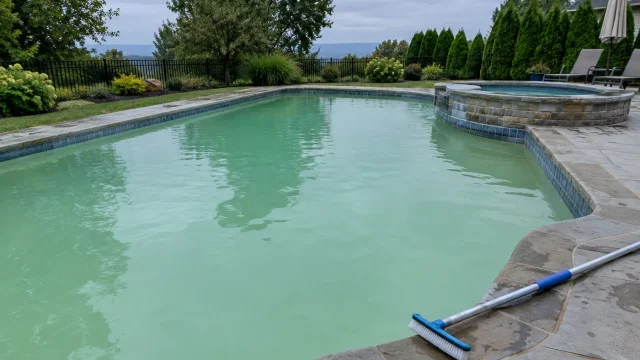
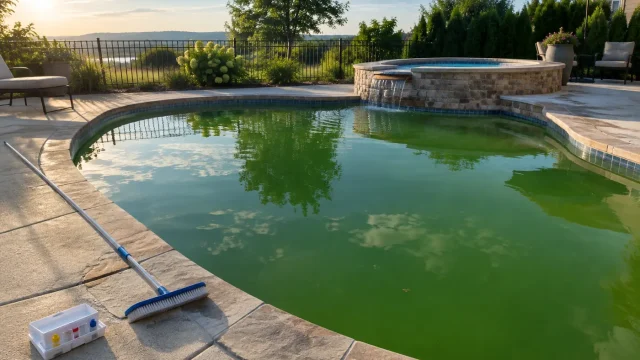
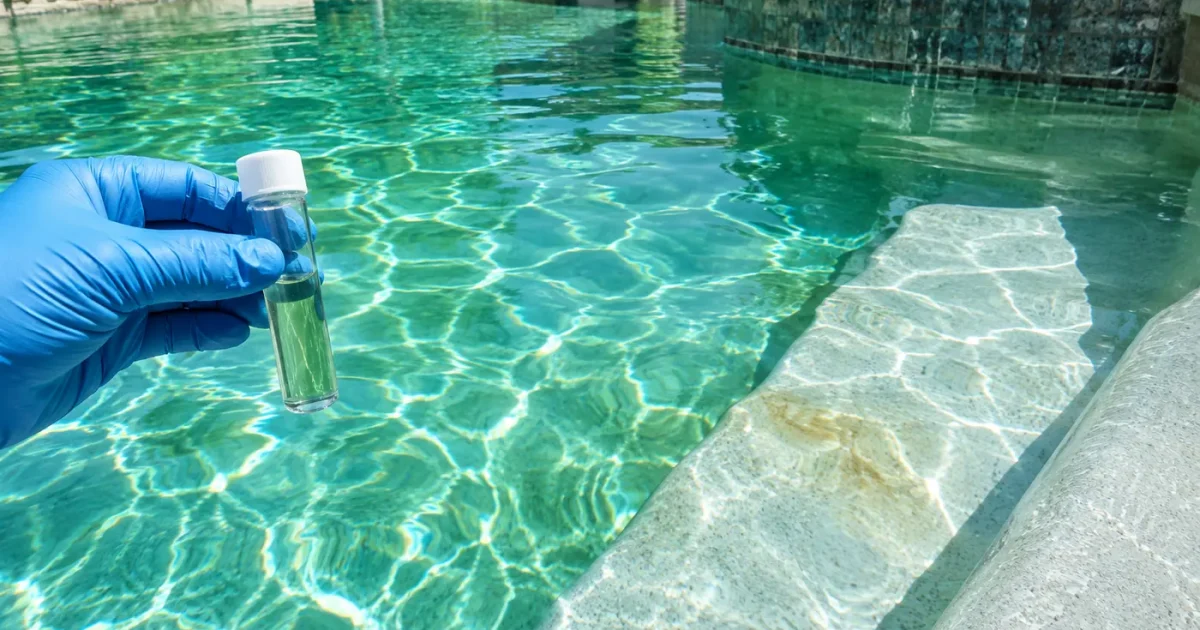
- The water is green, blue-green, brown or even reddish, but you can still see the bottom clearly.
- The walls feel smooth, not slimy.
- Free chlorine reads normal or high.
- The color showed up right after you shocked, opened the pool, or filled it from a well.
- More chlorine makes the color worse, not better.
- Stains show up on plaster, vinyl, steps or around the return jets.
Quick checks before anything else
- Look into the deep end: tinted but see-through, or murky?
- Run a hand along a wall or step to feel for slime.
- Test free chlorine and pH.
- Think back: was the color there before or after the last shock?
- Check where your fill water comes from: city water or a well.
- Note any copper sources: a copper algaecide, a mineral or ionizer system, or a heater.
What turns pool water green without algae?
- Iron LaMotte says green, red or brown water is usually iron. It often comes in with well water or a fresh fill.
- Copper Blue or blue-green water is due to copper, per LaMotte. Copper can come from algaecides, ionizers or corroded metal parts.
- Manganese Brown or black color usually means manganese, though iron can cause it too.
- A shock that oxidized the metals LaMotte explains that a shock oxidizes metals, which makes them fall out of solution and show up as color.
- Low pH eating metal parts LaMotte says a corrosive water condition can dissolve metal pool parts, and CDC notes pipes are more likely to corrode when pH is below 7.0.
The key sign is clarity. LaMotte’s rule is that water colored by metals stays see-through in the early stages, while turbid (murky) green water is usually algae. If your water is murky and the walls are slimy, go to our guide to green pool water instead. Our green and cloudy pool water hub lists every target number in one place.
Which metal is it?
| Water color | Likely metal | Common sources |
|---|---|---|
| Green, red or brown | Iron | Well water, fill water, rusting parts |
| Blue or blue-green | Copper | Copper algaecide, ionizer or mineral system, corroded copper parts |
| Brown or black | Manganese (sometimes iron) | Fill water |
Stains follow the same colors. LaMotte’s ideal level for both copper and iron is 0.0 ppm (parts per million), with an alert level above 0.2 ppm. Pools that run a copper ionizer on purpose hold copper higher; LaMotte says those systems run from 0.3 to over 1.0 ppm, so follow the system maker’s number.
Step-by-step: how to clear metal-colored water
We stop the chlorine first, find the metal, then bind it so it can be filtered or held in the water without staining. Doses differ a lot between products, so the label on your bottle is the rule.
- Stop shocking. High chlorine is what pulls the metal out as color. HTH’s metal control directions say not to shock before treating metal stains, because high chlorine oxidizes metals and makes staining worse. Keep normal chlorine in the water, but hold off on big doses.
- Rule out algae. Clear water, smooth walls and a normal chlorine reading point away from algae. If free chlorine is near zero, algae may be starting too, and you will need to treat both, metals first.
- Test for copper and iron. Use a metals test kit or strips, or take a water sample to a pool professional. LaMotte suggests a professional dissolved metals test right after treatment and at least once a month. A side clue: Taylor says a purple endpoint in its calcium hardness test means metal ions, most likely copper or iron, are interfering, and that they can come from algaecides, pipes or the water itself.
- Fix pH and alkalinity. LaMotte’s treatment starts with adjusting pH and total alkalinity to their ranges. Its stain guidance puts pH at 7.2 to 7.6 and its scale guidance puts alkalinity at 80 to 120 ppm. Our pool chemistry hub explains the order, and our pool calculator works out the doses.
- Add a sequestering agent. A sequestering agent (also sold as metal or stain and scale control) binds metals so they stay dissolved and do not drop out as color or stains. Add it with the pump running, as the label says. For example, HTH’s label calls for 10 fl oz per 10,000 gallons as a first treatment and says not to shock for 8 hours afterward.
- Run the filter, brush and vacuum. LaMotte’s colored water treatment lists brushing, vacuuming and running the filter after the sequestering agent goes in. Brush where color has settled, especially on the floor and steps.
- Retest metals, pH, alkalinity and hardness. LaMotte says to retest and, if calcium hardness is low, raise it to 200 ppm. Hayward’s heater manual lists low calcium hardness as corrosive to the heat exchanger.
- Find the source. If you fill from a well, LaMotte says fill water with metals should be treated with a sequestering agent and filtered before you add chlorine. If you used a copper algaecide, one EPA-registered copper algaecide label recommends a stain and scale control 2 days after the final treatment to remove leftover copper. If you run an ionizer, check its copper target with the maker.
- Protect the heater. Hayward builds its pool heater heat exchanger from copper and nickel and says low pH and low alkalinity are corrosive to it. Until the water is balanced, Hayward says to open the heater bypass if you have one, then close it again before you run the heater.
- Treat stains early. LaMotte says brushing can often remove fresh stains, but neglected stains in plaster pools may need the pool drained and acid washed. Act while the stain is new.
Stop. Do not mix a metal treatment with chlorine or acid in the same bucket or add them at the same time. HTH’s label says not to mix its metal control with other chemicals. Add one product, let it circulate, and follow each label’s wait time before the next.
Iron vs copper: how the fix differs
Iron. Iron usually arrives with the water. A well, a new fill or a big top-off is the classic setup, and the color often appears right when you shock. The fix is mostly about the fill: treat with a sequestering agent and filter before adding chlorine, as LaMotte advises, and test new fill water before opening the pool. LaMotte’s opening advice is to test for copper and iron before you dose the pool with a large amount of chlorine.
Copper. Copper usually comes from something you added or something wearing away. Copper algaecides and ionizers put it in on purpose, while low pH can dissolve it from copper parts such as a heater’s heat exchanger. Here the long-term fix is keeping pH and alkalinity in range and not overdosing copper products, as well as sequestering what is already there. A blue-green tint with a heater in the system is a reason to check your water balance before you heat the pool again; our pool heater problems hub covers heater care.
When to call a pool or spa pro
- Stains will not brush off, or they come back after treatment.
- Metal readings stay high after a full course of sequestering agent.
- You suspect the heater, pipes or other metal parts are corroding.
- A plaster pool may need draining and an acid wash.
- You run an ionizer or mineral system and are not sure of its copper setting.
Common questions
Why is my pool green but the water is clear?
Clear green water usually means dissolved metals, most often iron, rather than algae. LaMotte notes that metal-colored water stays see-through in the early stages, while algae makes the water murky. Test for copper and iron before adding more chlorine.
Why is my pool water green when the chlorine level is high?
High chlorine and green water together point to metals. Chlorine oxidizes iron and copper, which makes them visible as color. If the water is murky instead of clear, test CYA too, since too much stabilizer slows chlorine and lets algae grow even with a normal reading.
Why does my pool go green when I add chlorine?
A big dose of chlorine oxidizes metals in the water and makes them drop out as color. LaMotte says colored water often appears right after a fill or a shock treatment. Treat the metals with a sequestering agent first, then bring chlorine back up as the label allows.
Can low pH cause a green pool?
Indirectly, yes. Low pH makes water corrosive, and CDC notes pipes are more likely to corrode below pH 7.0. Corrosive water can dissolve copper from metal parts, and copper turns water blue-green. Raise pH and alkalinity into range to stop it.
Why is my pool water greenish blue?
A greenish blue or aquamarine tint is the classic sign of copper, according to LaMotte. Common sources are copper algaecides, ionizers and corroded copper parts. Test for copper and, if it is present, use a sequestering agent and fix pH.
Will shock clear a green pool if there is no algae?
No. If the green comes from metals, shock usually makes it worse because chlorine oxidizes the metals. Shock only clears green water caused by algae. For metals, use a sequestering agent and run the filter, and see pool cloudy after shock if haze shows up after a shock as well.