Common symptoms
- The water turned milky white or hazy within hours of adding shock.
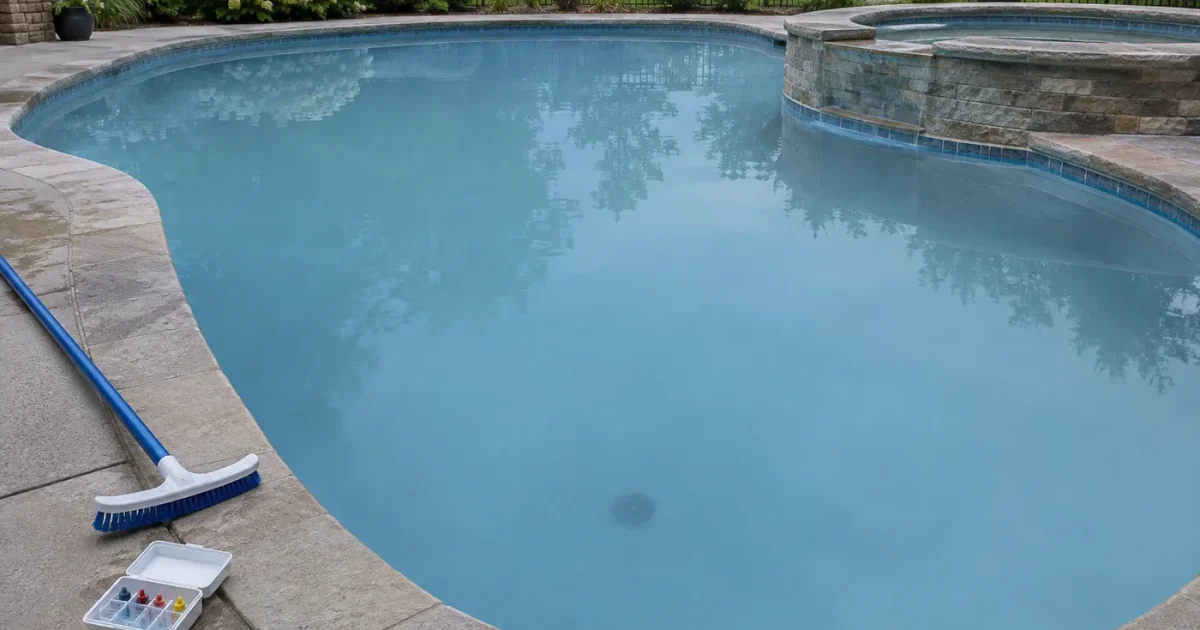
- The pool was green before the shock, and now it is a cloudy blue-gray or pale green.
- You can no longer see the main drain in the deep end.
- Fine white or gray dust settles on the floor overnight.
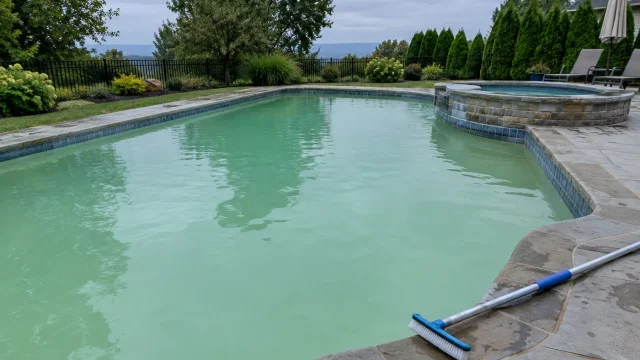
- The water is see-through but tinted green, brown or blue-green after the shock.
- The filter pressure gauge climbs faster than usual in the days after shocking.
Quick checks before anything else
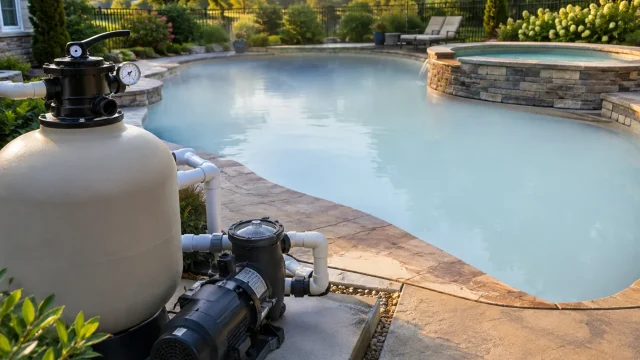
- The pump is running and the filter valve is set to Filter, not Waste, Recirculate or Closed.
- You gave the shock time to mix. LaMotte, a test kit maker, says never to test a water sample right after a shock treatment.
- You took the test sample away from the return jets and any chemical feeder.
- You know which shock you used: liquid chlorine, cal-hypo granules, dichlor, or a non-chlorine shock.
- You looked down into the deep end: murky water, or clear water with a color tint?
- You compared the filter pressure gauge with its clean reading.
Why does a pool get cloudy after shock?
- Dead algae and debris The shock worked, and now the filter has to catch everything it killed. This is the usual haze after shocking a green pool.
- High pH from a basic shock LaMotte lists liquid chlorine at pH 13.0 and cal-hypo at 11.8, and it names cloudy, turbid water as a sign of high pH.
- Calcium from cal-hypo Every dose of calcium hypochlorite adds calcium. In hard water, extra calcium can fall out as a white haze.
- A filter that cannot keep up Short pump runs, a dirty cartridge or tired sand leave fine particles floating.
- Not enough chlorine to finish If free chlorine falls back near zero within a day, algae or swimmer waste is still using it up.
- Metals showing up LaMotte says a shock can oxidize metals in the water so they show as green, brown or blue-green color.
Step-by-step: clearing a cloudy pool after shock
Most cloudy water after a shock clears with filtering, time and a pH fix. We work from free steps to ones that cost money, and we test before adding anything else, because a second chemical on top of the first can make things worse. For dose amounts, use your product’s label and our pool calculator.
- Pump ran overnightFilter set to Filter, baskets clear
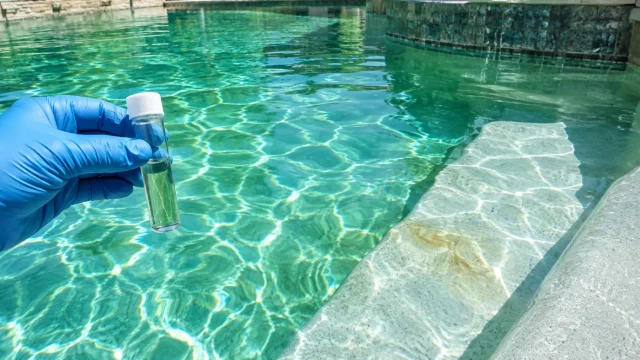
- Test free chlorine and pHDPD drop kit, sample at elbow depth
- Is free chlorine still well above your normal level?
Yes: the shock is still working. Keep filtering, fix pH, and clean the filter as pressure rises.
No: something used the chlorine up. Brush, shock again by the label, and check for algae, metals or a filter problem.
- Keep the pump and filter running. Haze only leaves the pool when the filter catches it. For cloudy water, LaMotte’s treatment says to run the filter for 24 hours. Empty the skimmer and pump baskets first so flow stays strong.
- Test the right way. Wait before testing, as LaMotte advises, then test free chlorine and pH. CDC says a DPD drop kit is more accurate than test strips. If the chlorine sample turns pink and then goes clear, LaMotte says the level is above 10 ppm (parts per million), and CDC says chlorine that high can bleach the test and give a false low or zero. Taylor, another test kit maker, says chlorine above 10 ppm can also make a pH test read wrong.
- Read the chlorine trend. If free chlorine is still high the next day, the shock is still working, so leave it and keep filtering. If it has dropped near zero, the shock was used up. LaMotte’s fix for hazy, slightly green water from algae is to superchlorinate to 30 ppm and brush the surfaces, and it notes daily brushing and several treatments may be needed.
- Bring pH back into range. CDC’s range is 7.0 to 7.8, and LaMotte calls 7.2 to 7.6 ideal. Liquid chlorine and cal-hypo both push pH up, and high pH alone can cloud the water. Lower it with acid by the label, with the pump running. Add acid and chlorine at separate times and never mix them; CDC warns that mixed pool chemicals can hurt people. If the pH climbs right back, see our guide on pool pH that won’t go down.
- Clean the filter as pressure rises. Dead algae clogs filters fast; LaMotte notes that algae can clog filter systems. Backwash a sand or DE filter, or hose off or swap a cartridge, whenever the gauge climbs well above its clean reading. Our guide to pool filter pressure explains what the gauge is telling you.
- Brush, then vacuum what settles. Brush the walls and floor once a day so dead algae and dust get back into the flow toward the filter. When fine dust settles on the floor overnight, vacuum it slowly so you do not stir it all back up.
- Test calcium if you used cal-hypo. LaMotte says that when water holds more calcium than it can, the extra falls out and clouds the water or forms scale. Taylor’s range for calcium hardness is 200 to 400 ppm. If yours is well above that, LaMotte’s fix is to replace part of the water with low-hardness water, and to ask a pool pro how much. Use liquid chlorine for your next shock.
- Check for metals if the water is tinted. LaMotte says water colored by metals stays see-through in the early stages and often shows up right after a shock. One HTH cal-hypo label registered with the EPA warns the product may promote metal stains and says to check for metals first. Brush, keep pH in range and use a metal sequestering agent by its label. Our guide to green pool water with no algae covers metal testing.
- Use a clarifier only after the basics. If the water is still hazy with chlorine, pH and the filter all in good shape, LaMotte says a pool pro may suggest repeated treatments or a clarifier. Follow the clarifier’s label, and expect the filter to need cleaning again soon after.
Stop. Keep everyone out of the pool while it is cloudy and while chlorine is high. LaMotte gives 4 ppm as a safe level to swim again after a shock, and the HTH label we checked forbids swimming above 4 ppm. Do not let anyone swim if you cannot see the main drain in the deep end.
Liquid chlorine vs cal-hypo vs dichlor: which shock clouds water more?
The shock you pick changes what the water does next. These pH figures come from LaMotte’s handbook, and the stabilizer figure comes from Taylor.
| Shock | Product pH | What else it adds | Cloudiness risk |
|---|---|---|---|
| Liquid chlorine (sodium hypochlorite) | 13.0 | No calcium or stabilizer | Raises pH; fix pH after |
| Cal-hypo (calcium hypochlorite) | 11.8 | Calcium with every dose | Raises pH and calcium; highest in hard water |
| Dichlor | 6.0 | Stabilizer: 6 to 7 ppm CYA per pound in 10,000 gallons | Low for haze, but CYA builds up |
| Non-chlorine (persulfate) | Not listed | No free chlorine | Will not clear algae haze |
Cal-hypo labels differ on how to add it. One older EPA-stamped label says to dissolve it in a bucket first to protect colored plaster, vinyl and fiberglass, while an HTH label says to broadcast it over the deep end. Follow your own label. For a green or hazy pool, we reach for liquid chlorine first, because it raises chlorine without piling on calcium or stabilizer. Taylor says too much stabilizer is most common in pools on dichlor or trichlor, especially when dichlor is used for shocking, and that it slows chlorine down.
Your filter type changes the cleanup. LaMotte’s filter advice for cloudy water: on a sand filter, look for gaps or hard spots in the sand, and plan on new sand every 3 to 5 years. On a DE filter, soak the fingers in filter cleaner or hose off the grids and check them for damage. On a cartridge filter, put in a clean cartridge and clean the dirty one for next time. For more on why water stays hazy, see our guide to cloudy pool water.
When to call a pool or spa pro
- The water is still cloudy after a few days of filtering, with chlorine and pH in range.
- Calcium hardness is far above 400 ppm and you need to know how much water to replace.
- The water or the walls show metal color or stains that brushing does not lift.
- Filter pressure stays high right after cleaning, or sand or DE blows back into the pool.
- You think the pool needs draining. Draining can damage some pools, so let a pro decide.
For the bigger picture on algae, metals and haze, start from our green and cloudy pool water hub.
Common questions
Why does shocking a pool make it cloudy?
Usually because the shock killed algae and other debris that the filter now has to catch. A basic shock like liquid chlorine or cal-hypo can also push pH up, and LaMotte lists cloudy water as a sign of high pH. Cal-hypo adds calcium, and in hard water that can come out as haze.
How long does it take shock to clear a cloudy pool?
No maker gives a set time, because it depends on how much was killed and how well the filter keeps up. LaMotte’s cloudy water treatment calls for 24 hours of filtering, and it notes algae can take several treatments. If the water is no clearer after a full day of filtering, test chlorine and pH and clean the filter before adding anything else.
Should I shock my pool if it is cloudy?
Only if the test calls for it. Shock helps when free chlorine is low or algae is growing, but it will not fix haze from a dirty filter, high pH or high calcium. Test first, and fix pH before you add more chlorine.
Why is my pool still cloudy and green even after shocking it?
The most common reason is that the shock was too small for the algae, so free chlorine ran out before the algae died. LaMotte’s algae fix is to superchlorinate to 30 ppm and brush, repeating as needed. If the green is see-through rather than murky, test for metals, since LaMotte says a shock can bring out metal color.
Do I add more chlorine if my pool is cloudy?
Add more only if your test shows free chlorine has dropped low. If chlorine is still high, more will not help, and the filter is the thing to work on. Keep in mind that chlorine above 10 ppm can bleach a DPD test, so a zero reading right after a big shock may be false.
Is it safe to swim in a cloudy pool?
No. Cloudy water can hide a swimmer in trouble, and right after a shock the chlorine is too high. Wait until you can see the main drain clearly and free chlorine is back to 4 ppm or lower, the re-entry level LaMotte gives.